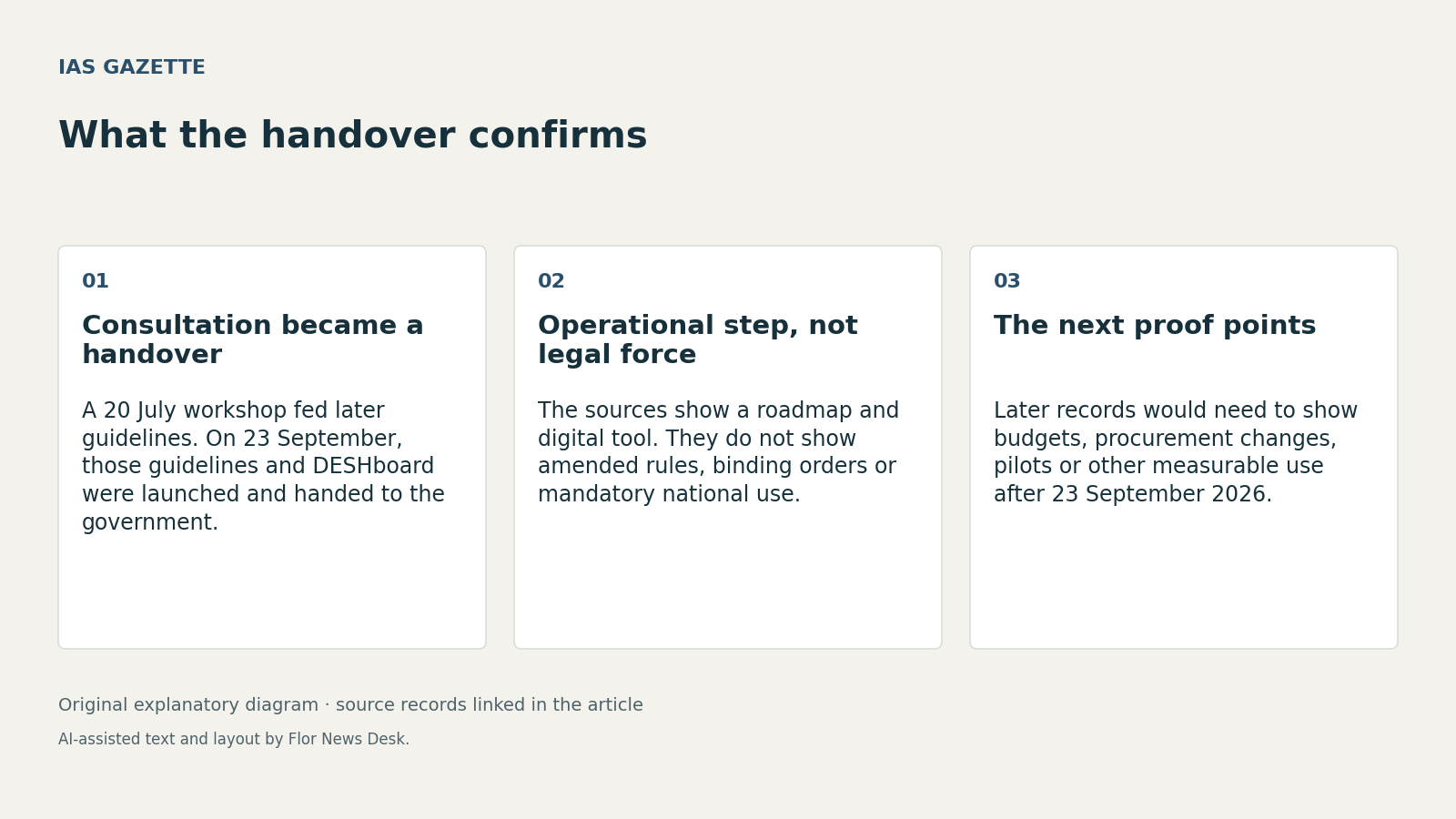
Bangladesh’s sustainable-building agenda crossed an administrative threshold on 23 September 2026, when the HBRI-DESH Implementation Guidelines and the DESHboard digital tool were launched in Dhaka and formally handed to the Government of Bangladesh at an event hosted by the Housing and Building Research Institute under the Ministry of Housing and Public Works, according to a UN-hosted press release. That is more than July’s consultation stage, but less than proof of binding national adoption: the public record shows a government-facing implementation package, not yet legal compulsion, funded rollout or measured results. UN Bangladesh launch release
The distinction matters because the earlier 20 July 2026 workshop was explicitly about shaping later steps, not closing them. A separate UN-hosted release says HBRI led a stakeholder consultation with UN-Habitat, UNEP and UNOPS under the project Transforming the Built Environment through Sustainable Materials in Bangladesh, funded by the German Federal Ministry for Economic Cooperation and Development (BMZ). That record says participants discussed governance, financing, digital systems and partnerships expected to inform later implementation guidelines and a phased rollout. Read together, the July and September records support a procedural reading: Bangladesh has moved from framework design and consultation into an asserted implementation phase, but the state actions that would give the framework regulatory force remain outside these documents. UN Bangladesh consultation release UN Bangladesh launch release
What the September event appears to add is administrative ownership. The release says the guidelines were handed to the government and that remarks came from an Additional Secretary at the Ministry of Housing and Public Works. It also says earlier technical assistance by UNOPS, HBRI and UNEP developed the HBRI-DESH framework and DESHboard, while UN-Habitat later produced the implementation guidelines. That sequence matters analytically: the file is no longer only a technical framework and digital platform; it now comes with a named roadmap for how ministries and partner institutions could use them. UN Bangladesh launch release
Still, the sources stop well short of proving nationwide implementation. The September release says the guidelines address agency coordination, capacity-building, financing questions and a phased rollout with pilots and partnerships, but it does not attach legal text, cite amended building codes, publish procurement directions or identify domestic budget lines. The July release likewise treated rollout, pilots and partnerships as future expectations. As of 8 October 2026, these records therefore establish planning instruments and an official handover, not whether any pilot began, any funds were disbursed or any authority was obliged to apply HBRI-DESH. UN Bangladesh launch release UN Bangladesh consultation release
The institutional cast suggests why the next evidence will matter. The July consultation included officials or representatives from Rajdhani Unnayan Kartipakkha (RAJUK), the National Board of Revenue (NBR), Dhaka Power Distribution Company Limited (DPDC), Bangladesh Bank and other financial institutions, alongside universities, professional bodies and industry groups. That does not prove commitments from those bodies. It does show that any serious rollout would likely require decisions beyond HBRI itself, potentially touching planning approval, incentives, utilities and finance. UN Bangladesh consultation release
For diplomacy and governance readers, the most defensible conclusion is narrow but useful. The project now has a clearer national administrative home, a donor-backed implementation guide and a digital monitoring tool under a BMZ-funded programme with UN technical support. Whether that becomes functioning public policy will depend on later records showing incorporation into rules, procurement, budgets or demonstrable pilots. Until those appear, the 23 September launch should be read as an operational handover, not yet as evidence that sustainable-building standards have been enforced across Bangladesh. UN Bangladesh launch release
Read our editorial standards or send a correction to the editorial desk.