
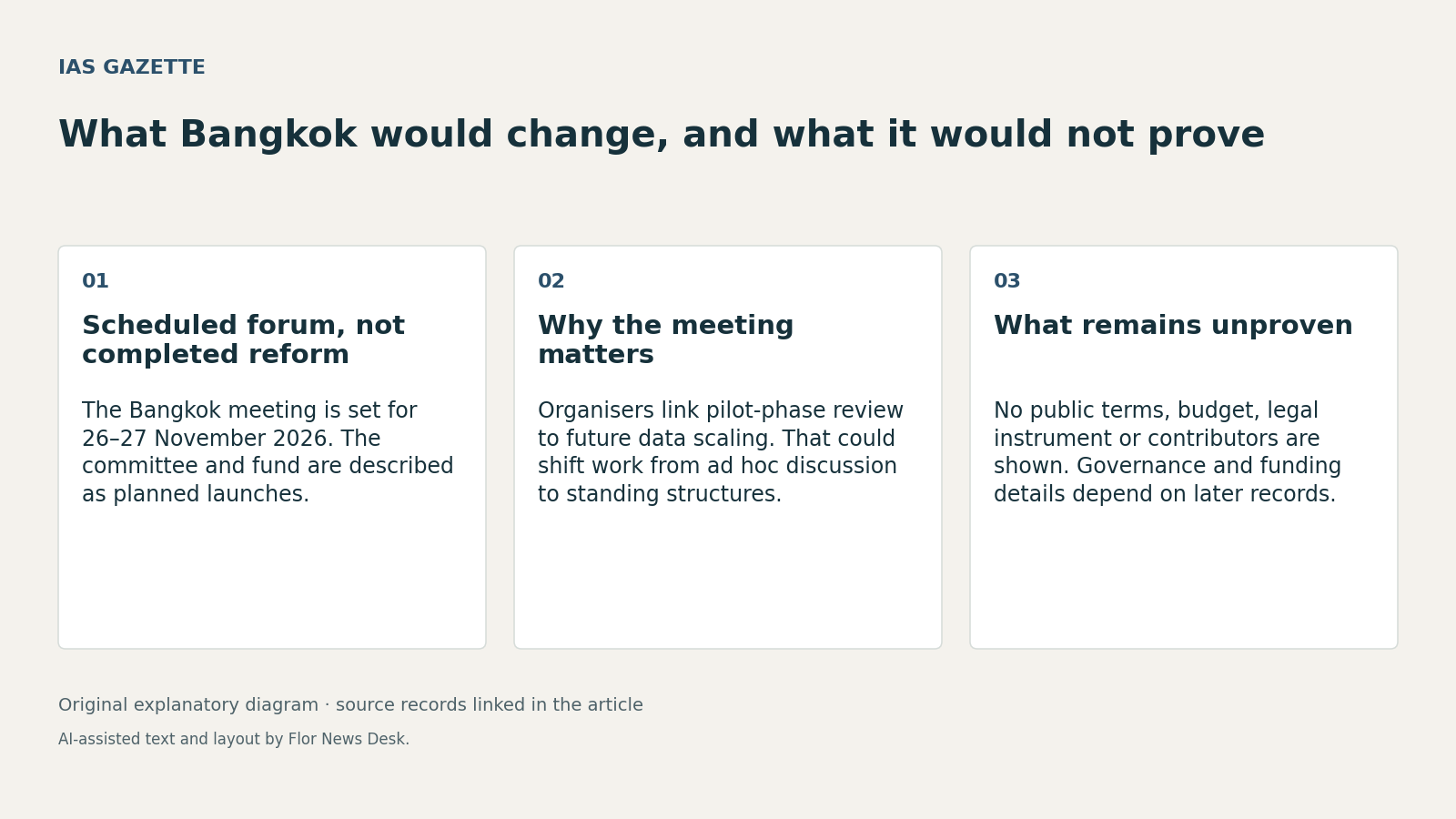
UN organisers have put a concrete date and venue behind a long-running measurement problem: the South-South Cooperation Data Forum is scheduled for 26–27 November 2026 at the United Nations Conference Centre in Bangkok, and the organiser page says the meeting will launch a Steering Committee on South-South Cooperation Data and a South-South Data Fund as country-led mechanisms (forum overview). A separate United Nations statistics calendar entry lists the same event in Bangkok, names UNCTAD and ESCAP as organisers, and says the listing data were extracted on 14 September 2026 (UNSD calendar).
That makes the Bangkok forum more than another technical workshop. According to the organiser page, the meeting is intended to review achievements from a pilot phase, exchange experiences and shape future work on measuring South-South cooperation, including priorities for scaling up data and using it to strengthen national policy, coordination and visibility in global processes (forum overview). The analytical significance is the shift in form: if the planned launches occur, measurement work that has been described as pilot activity would start to acquire named governance and financing vehicles.
What the public record does not yet show is just as important. As of 12 November 2026, the available pages do not provide terms of reference for the steering committee, membership rules, a legal instrument for the fund, budget figures, contributor lists, or any post-event decision record (forum overview). The language about launching both bodies is still prospective because the forum has not yet convened. That means readers should treat the committee and fund as planned institutional steps, not as established mechanisms with proven authority or resources.
The Bangkok timing also suggests an effort to place South-South data governance inside a wider regional policy calendar. The organiser page says the forum is being held back to back with the Asia-Pacific Directors-General Forum for South-South and Triangular Cooperation (forum overview). On the statistics side, the same United Nations calendar page lists the Committee on Statistics, Tenth Session, for 2–4 December 2026 in Bangkok as part of Asia and Pacific Statistics Week, scheduled for 30 November to 4 December 2026 (UNSD calendar). That does not prove a formal merger of tracks, but it does indicate a deliberate clustering of diplomatic and statistical meetings in one city over a short period.
For governments in the Global South, the practical issue is not whether data matter in the abstract, but who sets the reporting architecture and who pays to maintain it. The organiser materials frame the next phase as country-led (forum overview). Yet a country-led label, by itself, does not answer whether participating states will control methodology, whether UN bodies will retain secretariat power, or whether the proposed fund would support national statistical work, coordination units, or another function altogether. Those distinctions require documents that are not public in the current record.
The most useful way to read the Bangkok forum, then, is as a near-term institutional test. If organisers publish steering committee terms, named members, a fund instrument, or initial contribution commitments after 27 November 2026, the event will mark a move from pilot measurement to governed implementation. If they do not, the announced launch may remain mainly a signalling exercise. Based on the current sources, the reportable fact is the scheduled convening and its stated intent, not a completed overhaul of how South-South cooperation is measured or financed.
Read our editorial standards or send a correction to the editorial desk.