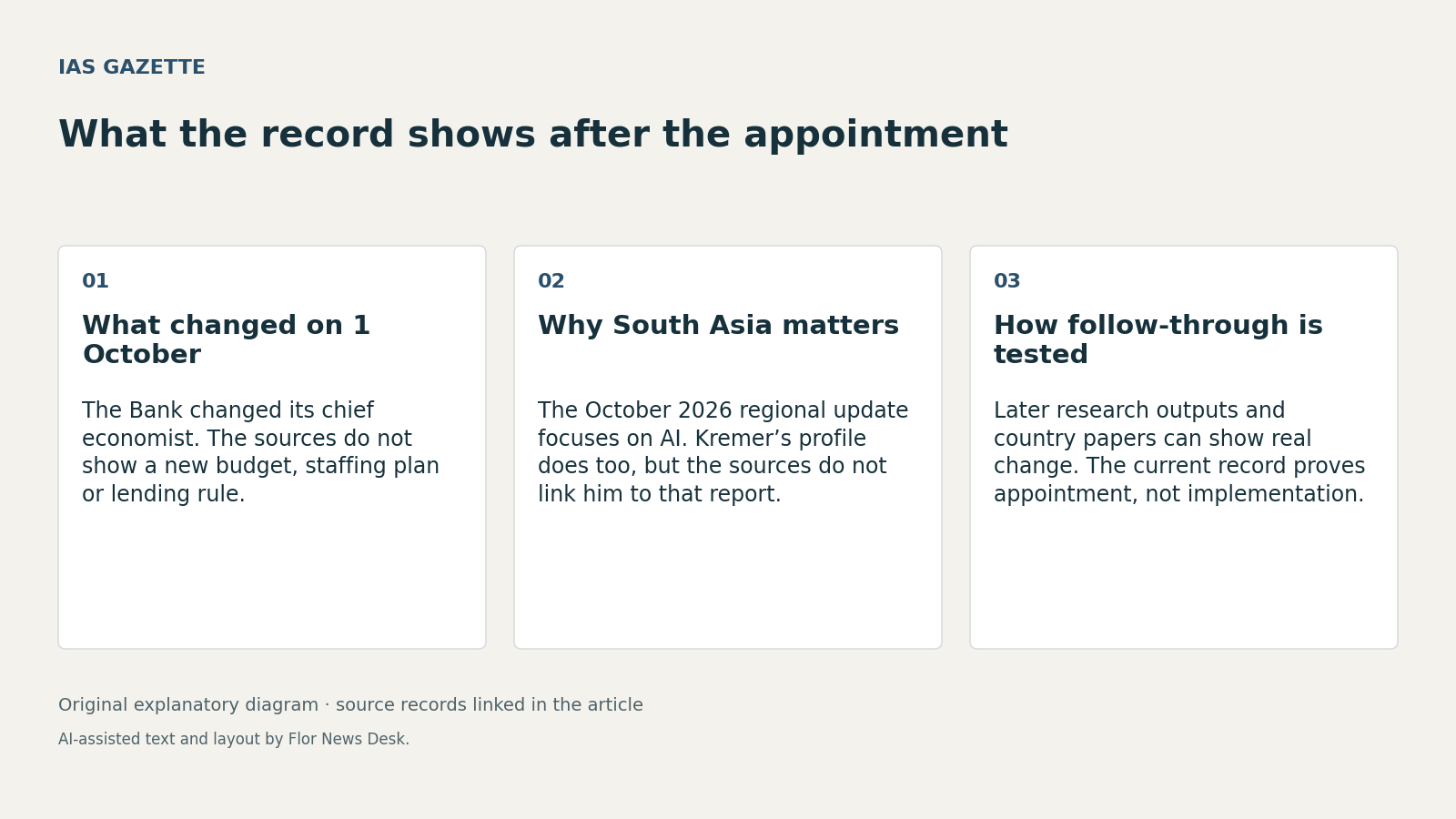
The World Bank’s decision to appoint Michael Kremer as Chief Economist and Senior Vice President for Development Economics is a real institutional change, not just a biography update. President Ajay Banga announced the appointment on 16 September 2026, and the Bank said it took effect on 1 October 2026. The significance lies in the remit: the Bank says this post leads its research, data and analytical work. What the current public record establishes, however, is the appointment itself, not any post-1 October reorganisation or change in Bank operations.World Bank press release World Bank leadership profile
The Bank’s own explanation of why Kremer matters points to a specific intellectual agenda. In its announcement, it identifies him as a joint winner of the 2019 Nobel Prize in Economics with Abhijit Banerjee and Esther Duflo, and highlights work on randomized evaluations, advance market commitments, deworming scale-ups, and digital agriculture and AI-based weather forecasting programmes in Africa and South Asia. Its leadership page adds that he directs the Development Innovation Lab, describes AI as a key priority there, and says India disseminated AI-based monsoon-onset forecasts to 38 million farmers in 2025 through related initiatives.World Bank press release World Bank leadership profile
That matters because a chief economist can change a multilateral institution before any loan document changes. Based on the Bank’s description of the job, the earliest effects would most plausibly appear in what research gets commissioned, which datasets or policy questions are emphasized, and how analytical work is framed for country teams. That is an inference from the documented remit, not proof of implementation. Neither the press release nor the leadership page records staffing changes, budget moves or a new directive for country programmes after 1 October 2026.World Bank press release World Bank leadership profile
For South Asia, the timing is notable but should be handled carefully. The World Bank’s South Asia Economic Update for October 2026 is themed around Adopting AI for Growth and projects regional growth averaging 6.8 percent in 2026-27. Its summary argues that larger AI gains depend on skills, business conditions, physical and digital infrastructure, support for small-firm adoption, local AI innovation, and clear rules on data security and privacy. That sits comfortably alongside the AI emphasis in Kremer’s profile. But the available sources do not show that he shaped this report. The appointment became effective on 1 October 2026, while the report page gives only the month of publication and no production timeline or authorship link to Kremer.South Asia Economic Update page World Bank leadership profile World Bank press release
The narrower conclusion is still useful. If the Bank continues to present Kremer through examples such as scaled health interventions, market-shaping vaccine tools and AI-enabled public service delivery, readers should expect those categories to gain visibility inside its research and analytical pipeline. That would not, by itself, prove a change in lending conditions or policy advice. As of 13 October 2026, the sources here support an institutional signal about priorities, not a verified shift in Bank practice.World Bank press release World Bank leadership profile South Asia Economic Update page
That makes the next stage of scrutiny straightforward. The evidence to watch is documentary: later Development Economics outputs, updated leadership or unit pages, and future regional or country analytical publications that repeatedly elevate the same themes. If subsequent South Asia documents begin to rely more heavily on evidence about AI adoption, scale-up mechanisms or experimentally tested interventions, that would be a stronger sign that the appointment has moved from symbolism into institutional practice. The present record does not yet establish that outcome.
Read our editorial standards or send a correction to the editorial desk.