

Governments can build a data-sharing platform and still leave the work that makes its information dependable without a clear owner. A World Bank roadmap published on September 16 puts institutional responsibility, incentives and staff capacity at the centre of the problem. For a public budget, that raises a concrete question: who pays to maintain the shared data after the initial project ends?
The roadmap by Roberto Pitea and Ravi Kumar argues that departments supplying data bear costs and risks that other users may not see. It calls for funding the work of preparing reusable information and for making the purpose and safeguards of sharing visible. This is a policy argument, rather than a measurement of how every government currently performs.
The work behind a usable record
Consider a hypothetical service that combines school records with an eligibility register. The technical connection might work perfectly while the two systems use different definitions of a household, different update dates or different identifiers.
Someone must decide which definition applies, document that decision and resolve exceptions. If a family moves, the service needs an update process. If a match is wrong, a person needs a way to challenge the result. Faster transmission alone cannot settle those questions.
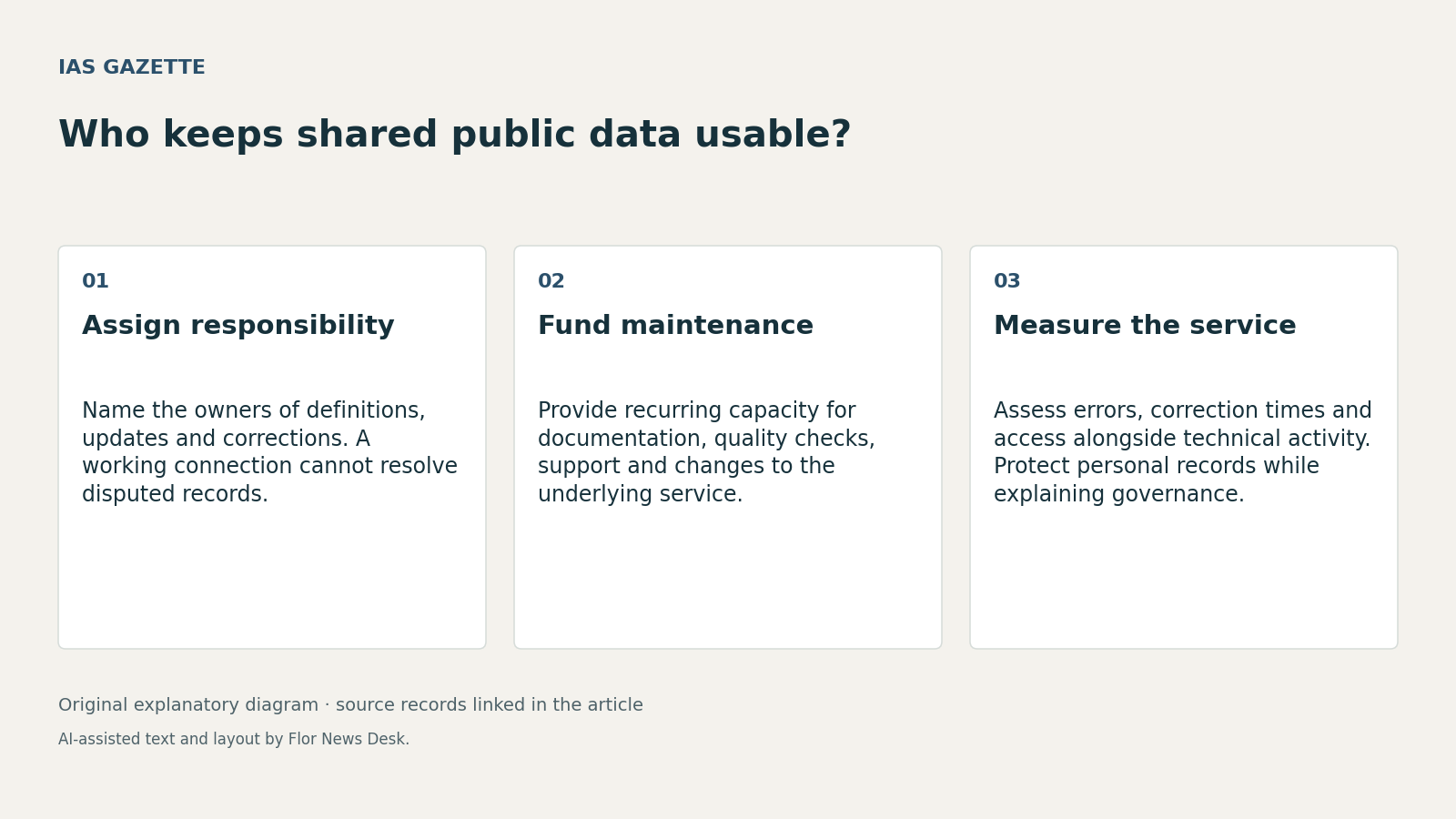
These examples explain why the operating budget matters. A one-time grant can pay for a connection. Continued reliability requires time for correction, documentation, user support and changes in the services that create the underlying records. An apparently inexpensive connection may therefore shift costs to a department that has no staff assigned to the task.
What the Kerala diagnostic contributes
The World Bank’s 2023 Kerala data diagnostic supplies an earlier institutional example. It identified needs around common standards, procedures and responsibility across the state’s data systems. Its recommendations included clearer coordination and resourcing, while distinguishing data governance from the provision of information technology.
The diagnostic also states limits: it drew on secondary research and interviews focused on government perspectives. It was not a comprehensive assessment of cybersecurity or infrastructure, and it did not encompass all perspectives outside government. It therefore cannot establish Kerala’s present performance in 2026 or serve as a current compliance finding.
Its value here is narrower. It illustrates the kinds of responsibilities that a new platform can leave unresolved and makes the difference between technical infrastructure and governing its use more concrete.
Make the continuing obligations visible
For a proposed sharing service, a useful budget document would identify the department responsible for each dataset, the expected update interval and the route for resolving conflicting records. It would also cost the work of maintaining definitions as policies change.
A public account need not expose personal records. It can describe what categories of information move, the service purpose, access restrictions and oversight arrangements. That gives citizens a basis for questioning the system without publishing the sensitive material itself.
Success should then be assessed against the service’s intended outcome. A larger catalogue or more connected agencies shows activity. It does not, by itself, demonstrate fewer incorrect decisions, quicker corrections or improved access.
The maintenance question turns a broad digital ambition into an accountable operating commitment: a named owner, a funded responsibility and evidence that the information remains fit for its purpose.
Read our editorial standards or send a correction to the editorial desk.