The European Union rejected the September 18 presidential vote in South Ossetia as legally invalid and reaffirmed Georgia's territorial integrity. The declaration is unequivocal, but the instruments behind it remain the same ones Europe has used since the 2008 war: diplomatic non-recognition, internationally chaired talks and an unarmed monitoring mission that is still denied access to the territory.
That distinction matters. A policy of non-recognition tells EU institutions and member states not to treat the vote, its legal framework or the authority it produced as legitimate. It does not cancel the de facto administration's control on the ground, open closed crossing points or give European monitors access across the administrative boundary line.
What the EU rejected
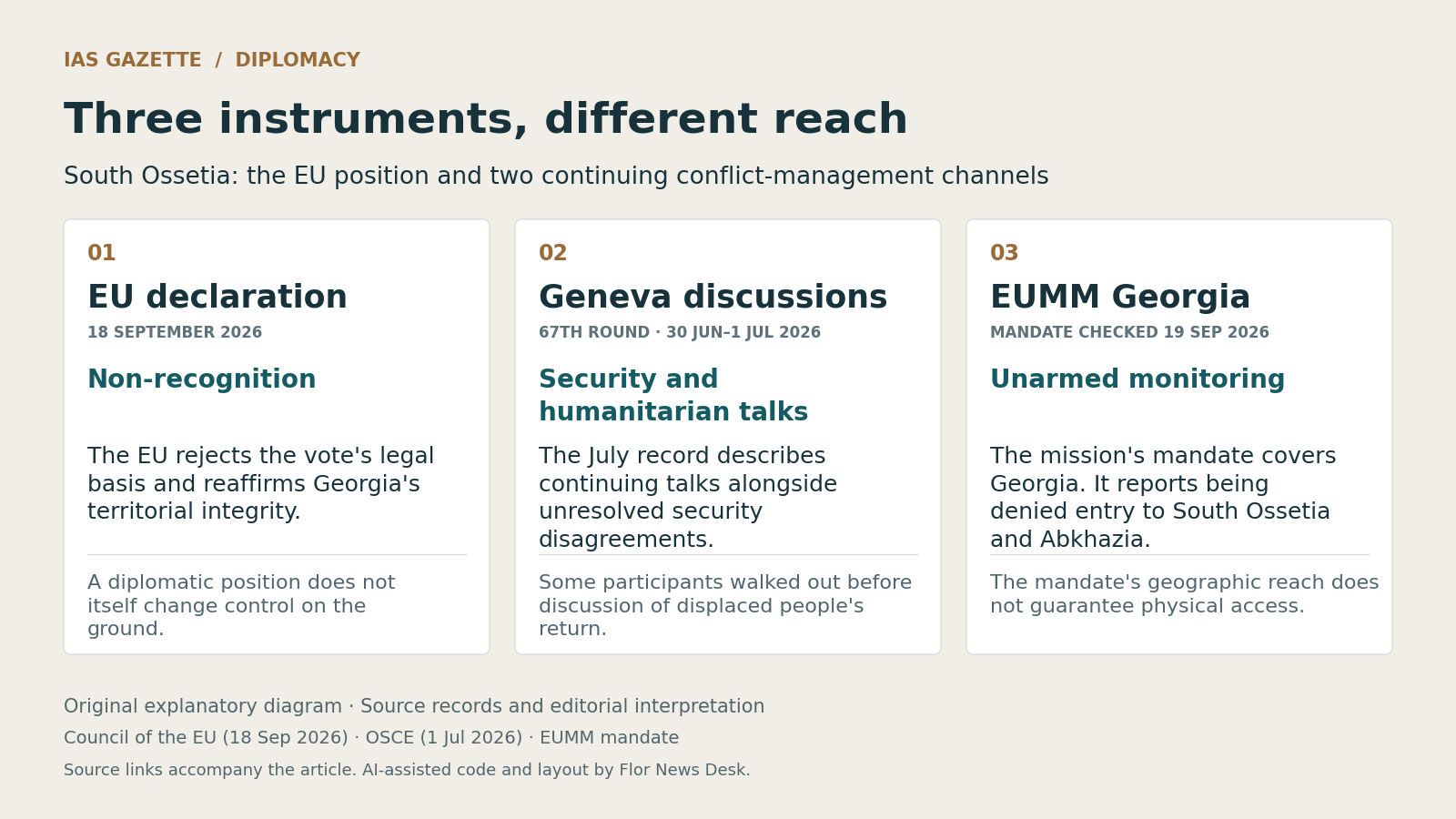
In a statement issued on September 18, the EU said it does not recognise the constitutional and legal arrangements under which the vote was held that day. It described the result as null and void and condemned Moscow's role in installing a Russian official as de facto president.
The statement also linked the vote to a May 9 treaty on deeper allied interaction with Russia. In the EU's account, the election and treaty are not isolated symbolic acts. They form part of a wider effort to incorporate South Ossetia into Russian political, military, economic and judicial systems.
These are the EU's positions, not findings produced by an international election-observation mission. The statement does not report an observer deployment, turnout verification or a competitive assessment of the ballot. Its objection begins earlier: the EU does not accept that the de facto authorities possess a lawful constitutional basis for holding the election at all.
Non-recognition is a boundary, not a settlement
The immediate consequence is diplomatic. EU bodies and governments can continue to deal with the territory's administration when practical conflict-management requires contact, while refusing to recognise it as the government of a sovereign state. The declaration also signals that an electoral title will not change the EU's treatment of the territory or Georgia's internationally recognised borders.
What the declaration cannot do on its own is change authority inside South Ossetia. For that, the EU points back to two mechanisms created after the August 2008 war.
The first is the Geneva International Discussions, co-chaired by the EU, United Nations and Organization for Security and Co-operation in Europe. At the 67th round on June 30 and July 1, participants worked in parallel groups on security and humanitarian questions. They discussed non-use of force, international security arrangements, crossings, documentation, livelihoods, missing persons, health and education. The next round was scheduled for November.
The record also shows the process's limits. Participants still held divergent positions on security. A discussion about the return of displaced people and refugees did not take place because some participants walked out. The forum remains valuable because the parties stay in the same process, not because it has resolved the basic dispute.
Monitoring without access
The second mechanism is the EU Monitoring Mission in Georgia. The mission says its mandate covers all of Georgia, but the de facto authorities in South Ossetia and Abkhazia have denied its monitors access to the territories they control. Its roughly 200 unarmed monitors instead patrol areas near the administrative boundary lines and report to EU policymakers.
That leaves much of the mission's practical work focused on preventing incidents and reducing harm around the boundary. The March 31 Incident Prevention and Response Mechanism meeting at Ergneti addressed movement restrictions, crossing points, detentions, new physical barriers and the hotline used to exchange information quickly. These are narrower concerns than political status, but they directly affect residents' daily lives.
The September 18 statement therefore changes the EU's public record more than the operational picture. It closes off any suggestion that the vote could produce recognition, while leaving conflict management to forums with long-standing access and political constraints.
What to watch next
The November Geneva round is the next scheduled multilateral test. Useful signs of movement would include substantive discussion of non-use of force, fewer obstacles to crossings, progress on detention cases or restored access for international monitors. None would settle the status dispute, but each would show whether diplomacy is reducing risk for people living near the boundary.
The harder test is whether the May treaty produces new administrative or security integration with Russia. The EU statement alleges a direction of travel, but it does not list implementing measures or a timetable. Any claim that annexation has occurred, or that a particular institution has been absorbed, will require separate documentary evidence.
For now, the EU has drawn a legal and diplomatic line. The contest over what happens beyond that line still depends on mechanisms designed eighteen years ago, operating with limited access and without agreement on the conflict's central questions.
Read our editorial standards or send a correction to the editorial desk.