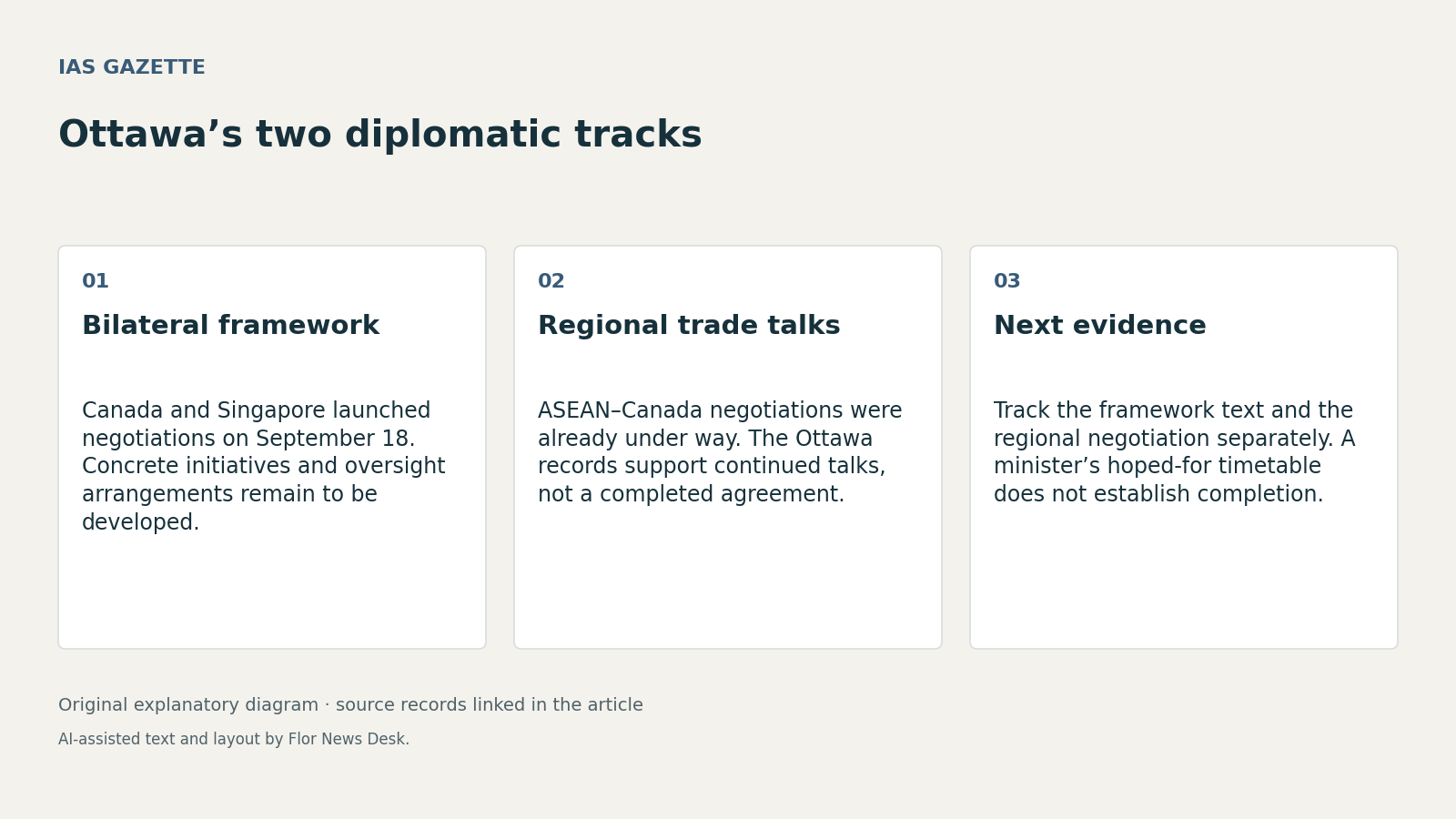
Canada and Singapore agreed on September 18 to negotiate a framework for economic cooperation. Their joint statement also sat alongside a separate diplomatic objective: completing the ASEAN–Canada free-trade negotiations already under way. Keeping those processes separate is essential to judging what the Ottawa meeting accomplished.
The joint statement, published by Singapore’s foreign ministry on September 19, records an intention to establish a Canada–Singapore Economic Partnership Framework. It leaves specific initiatives and arrangements for monitoring progress to further work. The document expressly rules out creating binding obligations for either government.
That gives the meeting a defined, limited result: an agreed direction for bilateral negotiations. Reading the framework announcement as a completed trade settlement would skip the decisions the ministers have left ahead of them.
Two different tests of progress
The bilateral process involves Canada and Singapore. The ASEAN negotiation has a regional scope. A further document agreed by the two governments could therefore demonstrate progress on their own framework without demonstrating that the ASEAN negotiation had concluded. Conversely, progress in the regional talks would not establish that a particular bilateral project was operating.
This distinction matters when following a sequence of ministerial announcements. The relevant question is which process a new document advances. A framework text, a project agreement and a regional trade agreement should each be assessed against their own stated terms. Counting them together as interchangeable agreements would conceal what remains undecided.
The September statement offers a useful starting point for that scrutiny because it leaves the implementation mechanism to be identified. A subsequent announcement naming that mechanism would answer a question the current record still leaves open. Its membership, reporting arrangements and remit would then provide concrete details against which to examine later claims of progress. These are questions for follow-up reporting, not features already established by this announcement.
The minister’s timetable remains an expectation
In his September 19 interview in Ottawa, Singapore Foreign Minister Vivian Balakrishnan said he hoped the framework could be ready within a couple of months. Asked about tangible outcomes, he described possible energy arrangements with technical matters unresolved, and discussions concerning essential supplies and digital payments. He hoped some agreements would be ready to sign in two to three months.
Those remarks give readers a time window to revisit, while leaving the terms and completion dates uncertain. A missed expectation, a signed instrument and a delivered project would be three different developments. Reporting should identify which one has occurred rather than carry the minister’s hopeful timetable forward as a fixed deadline.
Balakrishnan also expressed hope for an ASEAN–Canada negotiating breakthrough in the coming months or the following year. He did not announce that the regional talks had finished. His interview supplies Singapore’s account of prospects; it does not independently establish what every participant has accepted.
For a reader considering a practical trade decision, the next useful evidence would be the applicable agreement and its effective date. For a reader assessing diplomacy, an agreed framework text would itself be a meaningful next milestone. The Ottawa records support tracking both questions, with separate evidence for each.
Read our editorial standards or send a correction to the editorial desk.