
The European Union has urged further action on women’s representation in senior OSCE roles, particularly in field presences, while welcoming progress in recruitment. Its statement to the September 17 Permanent Council meeting, published the following day, also called on participating states to nominate qualified women for seconded positions. EU statement
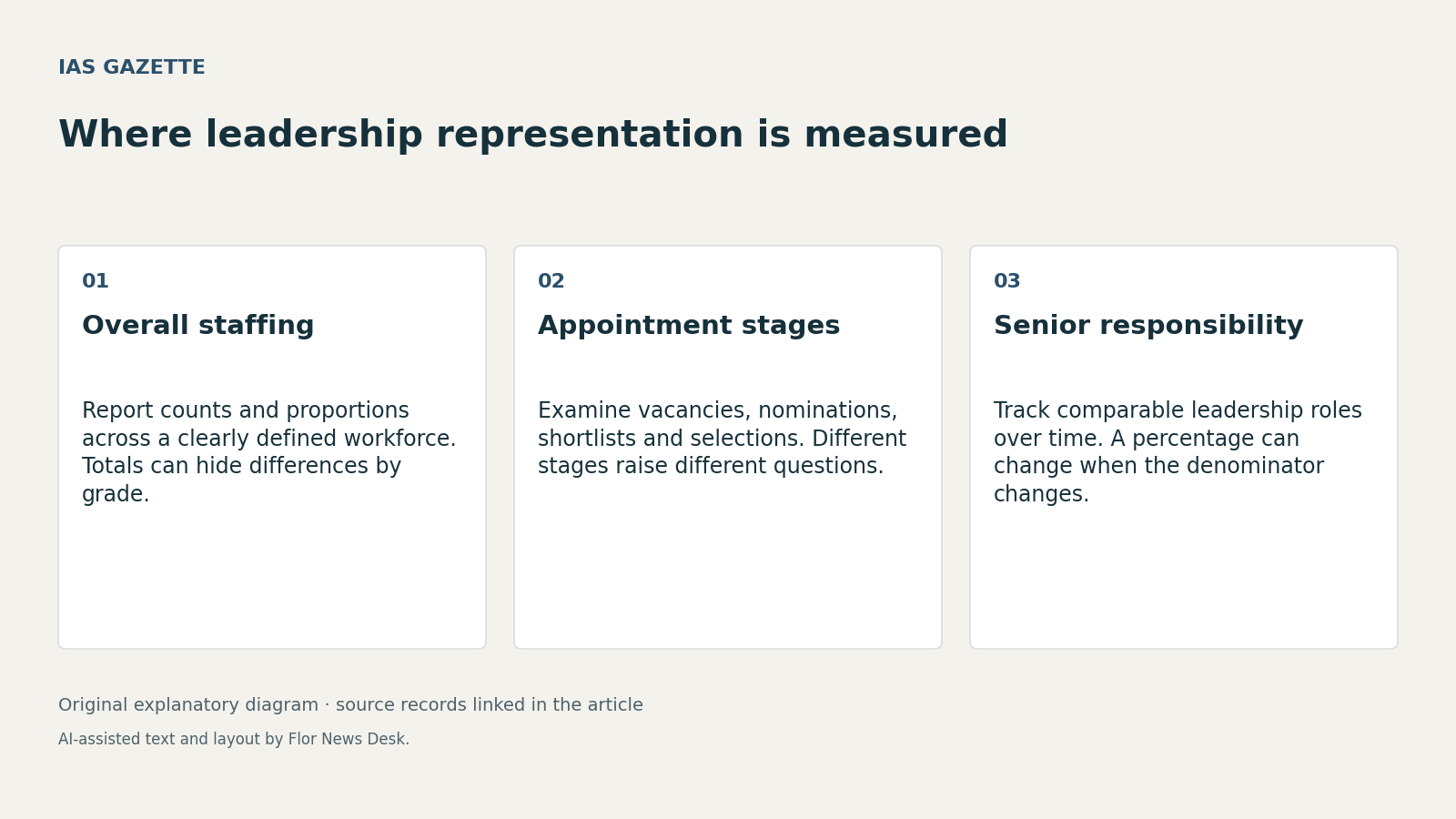
The intervention raises a specific accountability question. An organization’s overall staffing balance can improve without a comparable change in who holds senior responsibility. Understanding the difference requires information about roles and appointments, as well as a total headcount.
The statement is the EU’s assessment. It does not supply the complete staffing tables needed for an independent calculation of current representation, and this analysis does not substitute invented figures for those records.
Recruitment totals and leadership answer different questions
Consider a hypothetical organization with 100 employees, including 50 women. If only two of its ten senior roles are held by women, the overall proportion is 50 percent while the senior proportion is 20 percent. Both descriptions can be accurate.
The example is arithmetic, not an estimate of OSCE staffing. It shows why a claim about balance needs a stated denominator. Combining different grades, contract types or offices can conceal a pattern that becomes visible when the categories are separated.
Change over time also needs care. If several positions disappear, the percentage can rise while the number of women in leadership remains unchanged. A useful table would therefore report both counts and proportions, with comparable role definitions for each year.
The appointment process extends beyond the organization
The EU’s call for nominations identifies another part of the process: the contribution of participating states to filling seconded positions. Examining only final appointments would leave earlier stages unexplained.
An informative account could distinguish available posts, nominations, shortlists and selections. Different patterns at those stages would raise different questions. A small pool of nominations would point toward one part of the process; a large pool followed by few appointments would require examination of another.
That does not establish discrimination in an individual decision. Such a conclusion would require the relevant evidence and a fair assessment of the circumstances. Aggregate statistics can identify where further investigation is needed without proving its result.
A longstanding commitment needs specific measures
The 2004 OSCE Action Plan for the Promotion of Gender Equality sets out commitments across the organization and participating states. Its provisions include support for women’s participation in political and public life and in conflict prevention, crisis management and post-conflict reconstruction.
The 2026 EU intervention also calls for stronger monitoring and accountability across OSCE activities. A practical response would need named responsibilities, a reporting interval and measures tied to the concern being addressed.
For leadership representation, those measures should let readers follow appointments and vacancies through time. For a programme’s effects, staffing figures alone would be insufficient; the relevant evidence would concern participation and outcomes within that programme.
The distinction keeps the assessment focused. Recruitment progress is meaningful, but the EU’s question about senior responsibility requires its own records and its own explanation.
Read our editorial standards or send a correction to the editorial desk.