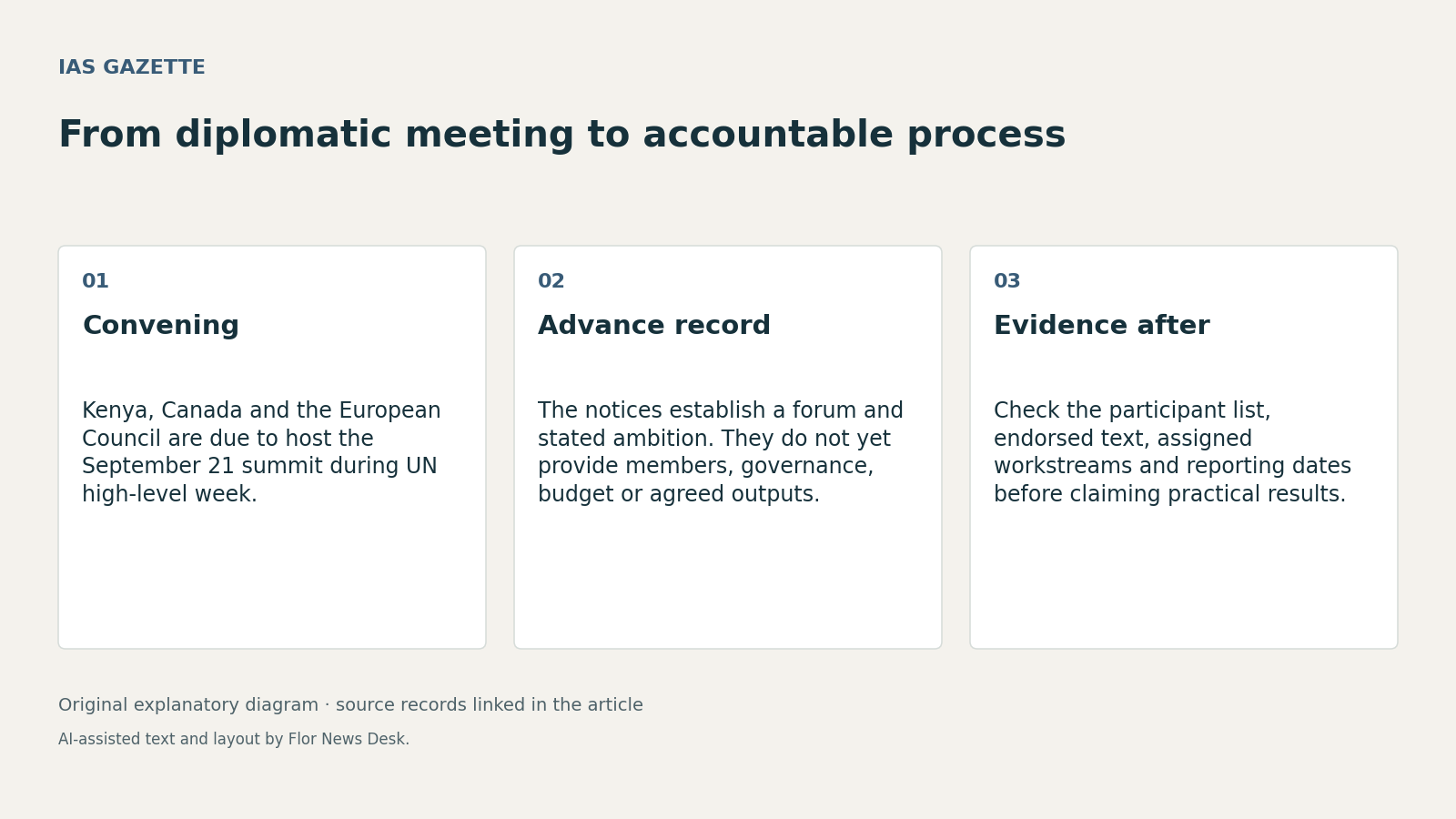
The leaders of Kenya, Canada and the European Council are due to convene a summit on multilateralism in New York on September 21. The meeting has a broad ambition, but its first public records establish a gathering and an intended direction. They do not yet establish a new institution or a completed programme of action.
The European Council's event notice describes the Partners for multilateralism, international law, peace and prosperity summit as an open platform for dialogue, coalition-building and practical cooperation. It says the initiative is intended to support the United Nations and other multilateral formats. The notice does not publish membership rules, a decision procedure, a budget or a reporting timetable.
That distinction matters before the meeting begins. Convening leaders can create political space for cooperation. It does not, by itself, show what participating governments have accepted or who will carry later work.
The venue and the initiative have different authority
The summit is scheduled during the United Nations General Assembly's high-level week, but the published record describes it as an event in the margins of the General Assembly. The Council's UNGA agenda separately identifies António Costa's September 24 address to the Assembly on behalf of the European Union and the September 21 summit with Canada and Kenya.
Those entries should not be merged into a single institutional act. A side summit may influence debate or assemble a coalition. A General Assembly address states a position. Neither becomes a UN decision merely because it occurs during the same week. Any later claim of a UN mandate would need a record from the relevant UN body.
The same care applies to the word “partners.” Before a participant list or joint text is released, the three named hosts are not evidence that every government attending high-level week has joined the initiative. A photograph, attendance at a session and endorsement of a final statement would also represent different levels of participation.
A crowded itinerary is evidence of contact, not consensus
The EU's September 18 programme for High Representative Kaja Kallas lists meetings on humanitarian law, security partnerships, food security, maritime cooperation, climate security, accountability and Palestine. It also records planned bilateral and ministerial meetings.
The itinerary is useful for identifying the subjects and groups the EU intends to engage. It cannot show, before those meetings occur, whether the participants agree on language, establish a workstream or make a deliverable commitment. Reporting that turns a scheduled meeting into an agreed policy would erase the negotiation still to happen.
What would turn the summit into an accountable process
The event page says leaders will hold a press conference afterward. That can clarify positions and identify disagreements, but spoken intentions are not the same as a durable mechanism.
The strongest follow-up evidence would be a dated participant list, a final text showing who endorsed it, named workstreams, assigned responsibility and a timetable for reporting. Financial claims would require a documented commitment and later evidence of disbursement. Institutional reform claims would require action by the institution with authority to make the change.
Until those records appear, the summit can be described accurately as a high-level attempt to build a cross-regional coalition. Whether it produces practical cooperation is the question the meeting opens, not a result its advance notices have already proved.
Read our editorial standards or send a correction to the editorial desk.