

ASEAN’s ambition for a digital economy approaching $2 trillion by 2030 is best understood as a scenario dependent on policy choices. The figure comes from a 2023 study informing the Digital Economy Framework Agreement, or DEFA. It should not be read as a measured outcome, an amount of public funding or a guaranteed benefit to every business.
The study’s public summary, prepared by Boston Consulting Group and supported by the Australian government, distinguishes a trajectory of roughly $1 trillion from a more ambitious outcome approaching $2 trillion. Its scope includes the digital core and digitally enabled economic activity. The document describes proposals that informed negotiations, rather than presenting its recommendations as agreed treaty obligations.
Follow one transaction across the border
Imagine a small manufacturer selling to a customer in another ASEAN market. This is a hypothetical example, but it provides a useful way to test what regional digital integration would mean.
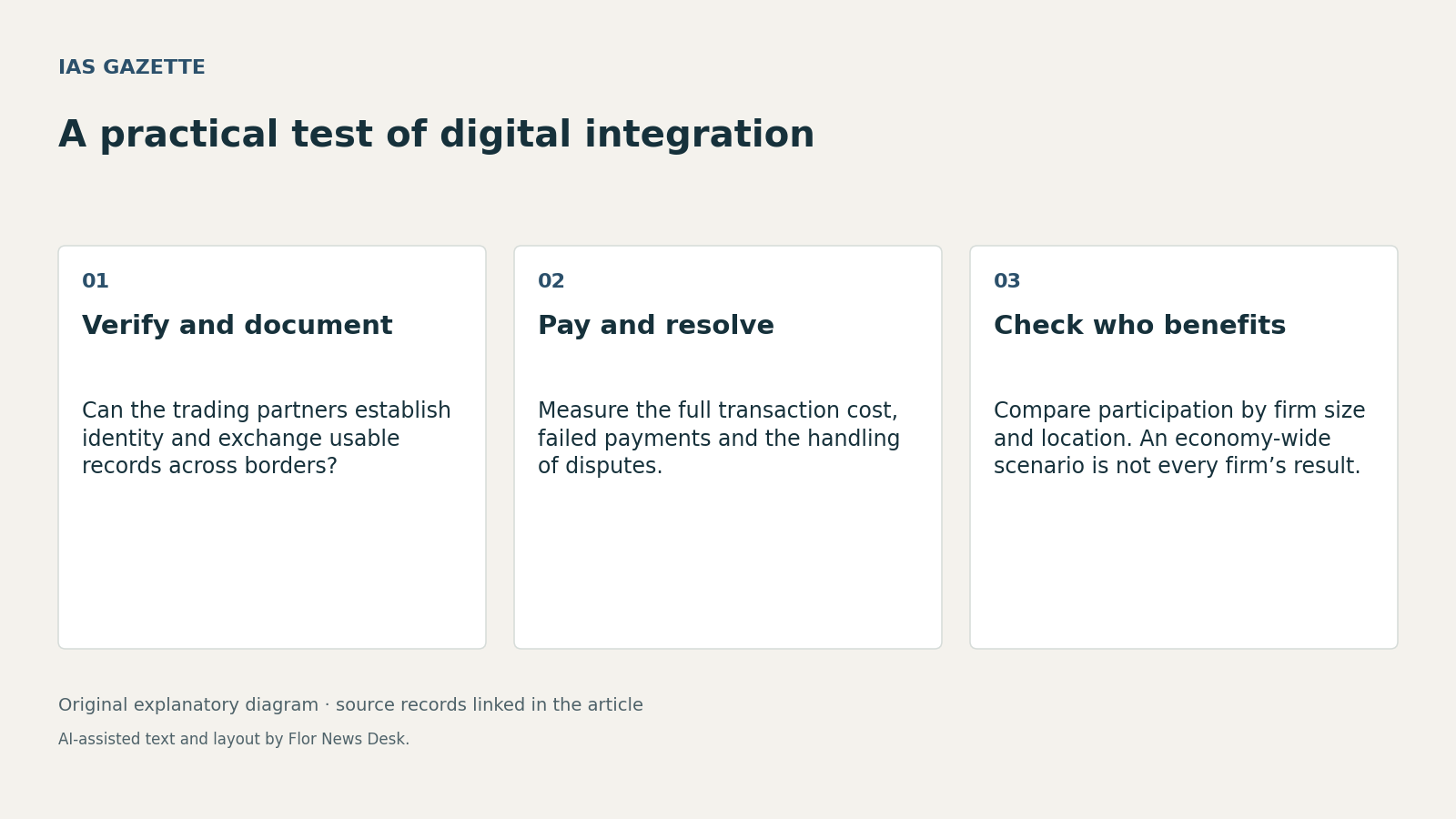
The buyer must be able to discover the seller and establish that the business is legitimate. An order needs to become an accepted document. Payment has to arrive at a predictable cost. The parties need arrangements for handling a mistake, a failed delivery or a disputed charge.
An improvement at one stage may leave another obstacle intact. Easier payment does little for a seller that cannot meet a destination market’s product requirements. A recognized digital identity does not itself make delivery affordable. Those dependencies help explain why an economy-wide forecast cannot be reduced to one successful technical connection.
A masterplan sets out the supporting capabilities
The ASEAN Digital Masterplan 2030 covers the 2026–2030 period. It emphasizes regional interoperability, digital skills, trusted services and participation across differing levels of national readiness. Its introduction explicitly presents a flexible framework for voluntary cooperation, rather than imposing obligations on member states.
That distinction matters when a business reads an announcement. A strategic objective can identify a direction and encourage investment. A business still needs the actual rules, participating services and implementation dates for the transaction it wants to complete. This analysis does not establish the current signing or entry-into-force status of DEFA.
Measure friction where firms encounter it
A practical scorecard could follow the same type of sale over time. How long does verification take? What documentation must be entered twice? What is the full payment cost? How often does a transaction fail, and how long does a dispute remain unresolved?
The sample would matter as much as the average. Large firms with established compliance teams may experience a service differently from small exporters. Results separated by firm size, location and first-time participation could reveal whether improvements are widely usable.
Such measures would not reproduce the consultants’ economic model. They would provide observable evidence about specific mechanisms expected to support growth. They could also expose a trade-off: faster processing accompanied by higher fees, for example.
The $2 trillion scenario gives the regional ambition a scale. A completed transaction shows where that ambition becomes practical. Connecting the two requires evidence that businesses can use the services, manage the risks and continue trading after a demonstration project ends.
Read our editorial standards or send a correction to the editorial desk.