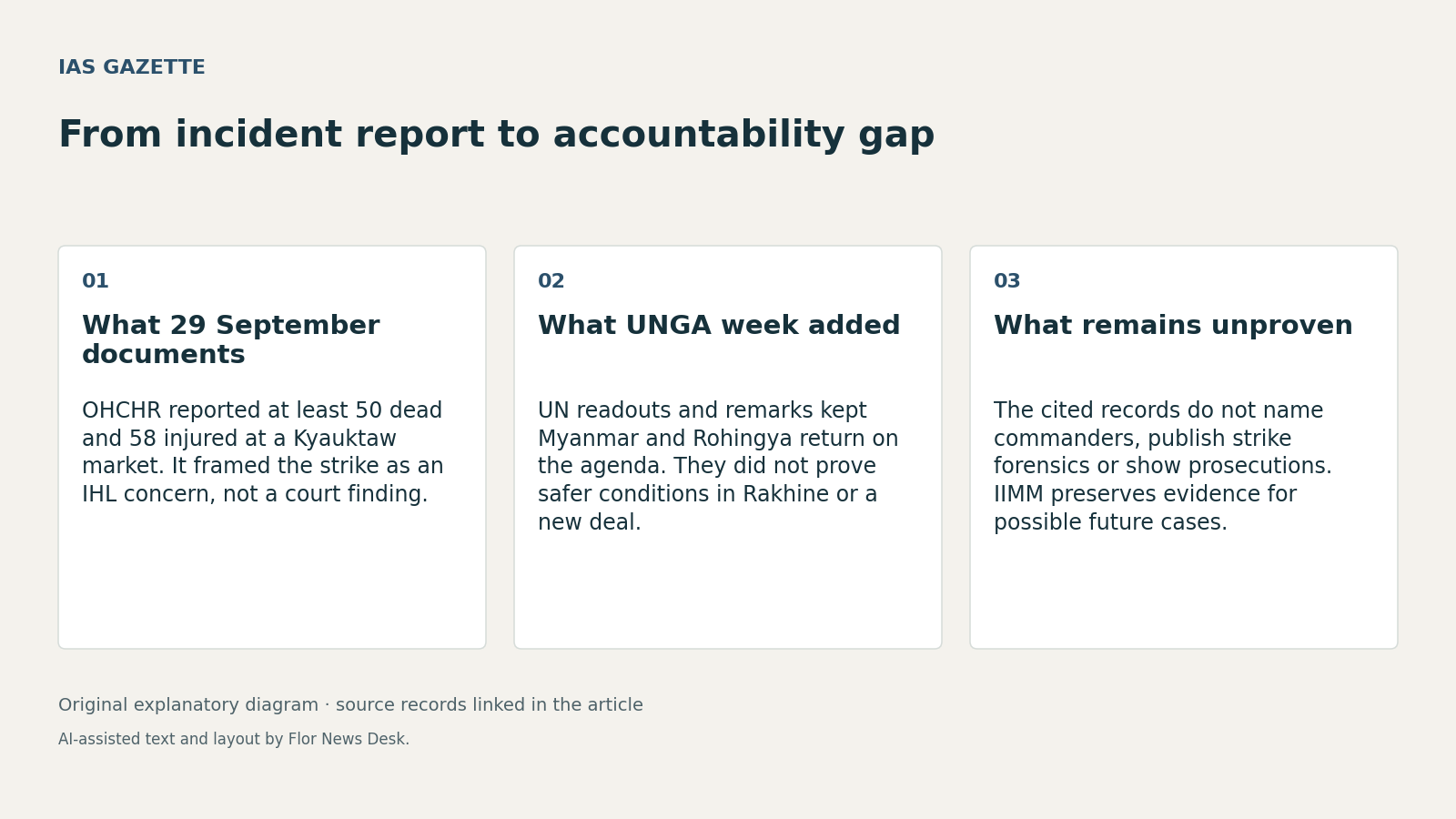
The UN human rights chief’s 29 September condemnation of reported airstrikes on a market in Kyauktaw township gave late-September diplomacy on Myanmar a sharper factual anchor: a specific alleged attack with reported mass civilian casualties. The UN Human Rights Office said military airstrikes reportedly killed at least 50 people and injured at least 58 more in Rakhine State, and that the toll could rise. It also said the market served Rakhine, Rohingya, Hindu and Daingnet communities and raised concerns about compliance with international humanitarian law principles on distinction, proportionality and precautions in attack. OHCHR statement
That is significant, but its limits matter just as much. The 29 September page is a UN press statement carrying reported casualty figures and reported attribution; it does not publish strike-site evidence, explain a verification method, identify a chain of command or establish a judicial finding. Even the timing is partly relative on the page, rather than fully dated in every reference. The same release also urged Malaysia to halt a reported plan to deport about 5,000 Myanmar nationals, but the page does not establish whether that plan was later stopped or carried out. OHCHR statement
The immediate diplomatic backdrop is thinner than the outrage conveyed by that statement. A 21 September readout from the President of the General Assembly said Khalilur Rahman and Special Envoy Julie Isabel Bishop discussed developments in Myanmar, the humanitarian situation, regional efforts, and the Rohingya situation in Cox’s Bazar, Bangladesh. It also said they stressed continued international attention, support for refugee-hosting countries and action on root causes, while noting a side event scheduled for 23 September. But the readout is non-verbatim and records no new decision, enforcement step or agreed response mechanism. PGA readout
Bishop’s remarks at that 23 September side event help explain why a Kyauktaw strike matters beyond one town. She said more than 1.2 million Rohingya were in Bangladesh, that more than 30,000 children are born each year in the Cox’s Bazar camps, and that the Joint Response Plan was 66 per cent funded. She also said Nay Pyi Taw remained committed to voluntary returns and a verification process with Bangladesh, while acknowledging it did not control all of Rakhine State, and she said conditions for safe, dignified and sustainable return were not available because conflict and abuses persisted. The analytical implication is straightforward: any fresh reported attack in Rakhine tests official return language against the security conditions described in the same UN forum. Special Envoy remarks
The accountability file is also clearer in structure than in outcome. On 24 September, the Independent Investigative Mechanism for Myanmar said it had collected and analysed evidence showing that many serious international crimes continue across Myanmar, and described Rakhine as highly volatile, with civilians frequently affected by aerial bombings, shelling, drone attacks, arbitrary detention, sexual and gender-based crimes, torture and killings. It also restated that conditions were not conducive to safe return, and noted that the Human Rights Council created the Mechanism in 2018 to collect and organize evidence for possible use by prosecuting authorities. That narrows the gap between allegation and possible future case-building, but not the gap to a present prosecution: the public statement does not release the underlying evidence set, identify suspects or make incident-level findings on Kyauktaw. IIMM statement
As of 4 October 2026, the four cited records show a layered but incomplete picture. They document reported civilian harm, continued diplomatic attention and an evidence-preservation mechanism. They do not establish criminal responsibility, a new UN enforcement move, the outcome of Bishop’s planned Bangladesh visit mentioned on 23 September, or any implemented regional step beyond calls for fuller cooperation and ASEAN’s Five-Point Consensus. For policymakers, that is the central distinction to watch: whether the next public record remains another condemnation, or begins to add verified incident evidence, named responsibilities or a concrete diplomatic action. Special Envoy remarks IIMM statement
Read our editorial standards or send a correction to the editorial desk.