
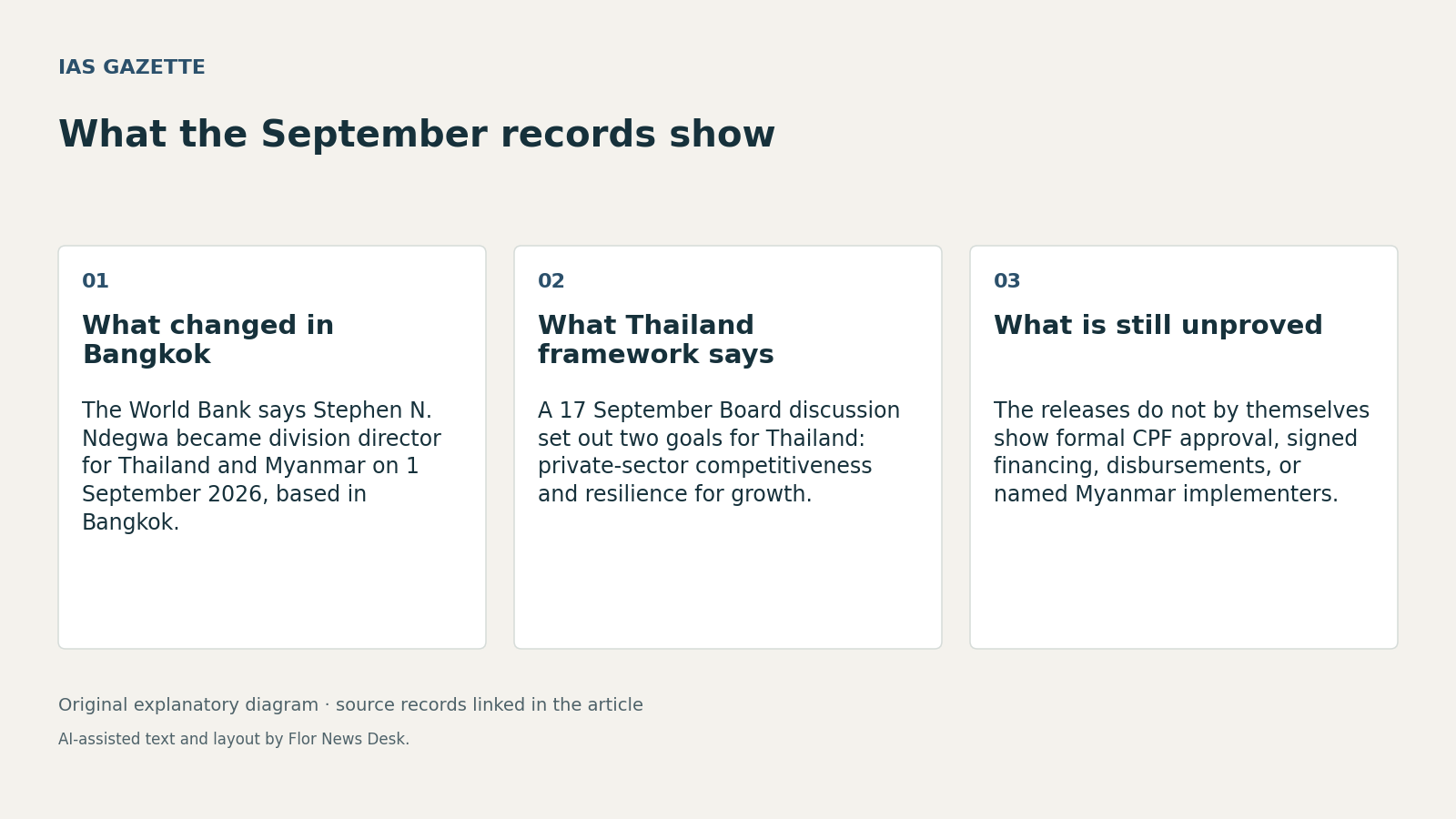
The World Bank has paired a leadership change in Bangkok with a fresh Thailand strategy, but the two September records establish intent more clearly than execution. The institution said Stephen N. Ndegwa became Division Director for Thailand and Myanmar, effective 1 September 2026 and based in Bangkok, and said on 17 September that its Board of Executive Directors discussed a new Country Partnership Framework for Thailand covering FY2027–FY2032 World Bank appointment release World Bank Board discussion release.
That combination matters because it places a locally based official over both a middle-income reform agenda and a fragile-state file at a moment of unusual attention on Bangkok. The World Bank’s Thailand page lists Ndegwa as division director, names Alejandro Alcala Gerez as operations manager, says the Thailand office has more than 190 staff, and says Bangkok is due to host the IMF and World Bank Group Annual Meetings from 12 to 18 October 2026 Thailand country page. On the Bank’s own account, this is not only an internal posting. It is a regional operating platform.
For Thailand, the published line is strategic rather than transactional. The 17 September release says the proposed framework combines knowledge and reform support with selective sovereign financing and private investment, and organizes that approach around two outcomes: a more competitive private sector and stronger resilience for growth World Bank Board discussion release. The 1 September appointment release adds that jobs and private capital mobilization are cross-cutting priorities World Bank appointment release. Read together, those records suggest the Bank wants its Thailand role framed less as headline lending volume than as a mix of policy leverage, selective finance and investor signalling.
The sector detail points in the same direction. The Board discussion release says planned support would cover productivity, innovation, digital adoption, access to finance for small businesses and job-linked sectors including advanced manufacturing, sustainable tourism, digital value chains and agribusiness World Bank Board discussion release. The same release says resilience work would span water, transport and energy infrastructure, fiscal resilience, disaster preparedness, social protection and Chao Phraya basin flood and drought resilience. Separately, the appointment release says current Thailand investments include resilient infrastructure, carbon markets, water security and flood-risk management World Bank appointment release. That distinction matters: “current investments” are not the same thing as new approvals under the next framework.
Myanmar sits in a different operational category. The World Bank says its approach there is to monitor, assess and assist, with support for vulnerable communities delivered through programs implemented by third-party partners World Bank appointment release. The record therefore shows a shared leadership structure for Thailand and Myanmar, but not a shared delivery model. For readers tracking development diplomacy, that is the clearest immediate implication of Ndegwa’s remit.
The limits of the evidence are also central to the story. The 17 September release says the Board discussed the Country Partnership Framework; by itself, that does not prove final Board approval, adopted text, signed financing or disbursement World Bank Board discussion release. The undated Thailand page says the previous FY2019–2022 framework, extended to June 2024, had concluded and that preparation of a new framework was in progress, language already overtaken by the later September release Thailand country page. So the current documentary record is enough to report a leadership decision and a declared policy direction, but not enough to claim that Thailand’s next financing package is settled or that Myanmar delivery arrangements are fully visible.
The practical test will come later in documents that show what the September announcements do not: final Board status, signed operations and named implementation channels. Until then, the World Bank has made its priorities legible in Bangkok. It has not yet shown, in the records used here, how much of that agenda is committed money, how much is still indicative, or how far a single Bangkok-based leadership line can bridge Thailand’s reform agenda and Myanmar’s constrained assistance model.
Read our editorial standards or send a correction to the editorial desk.