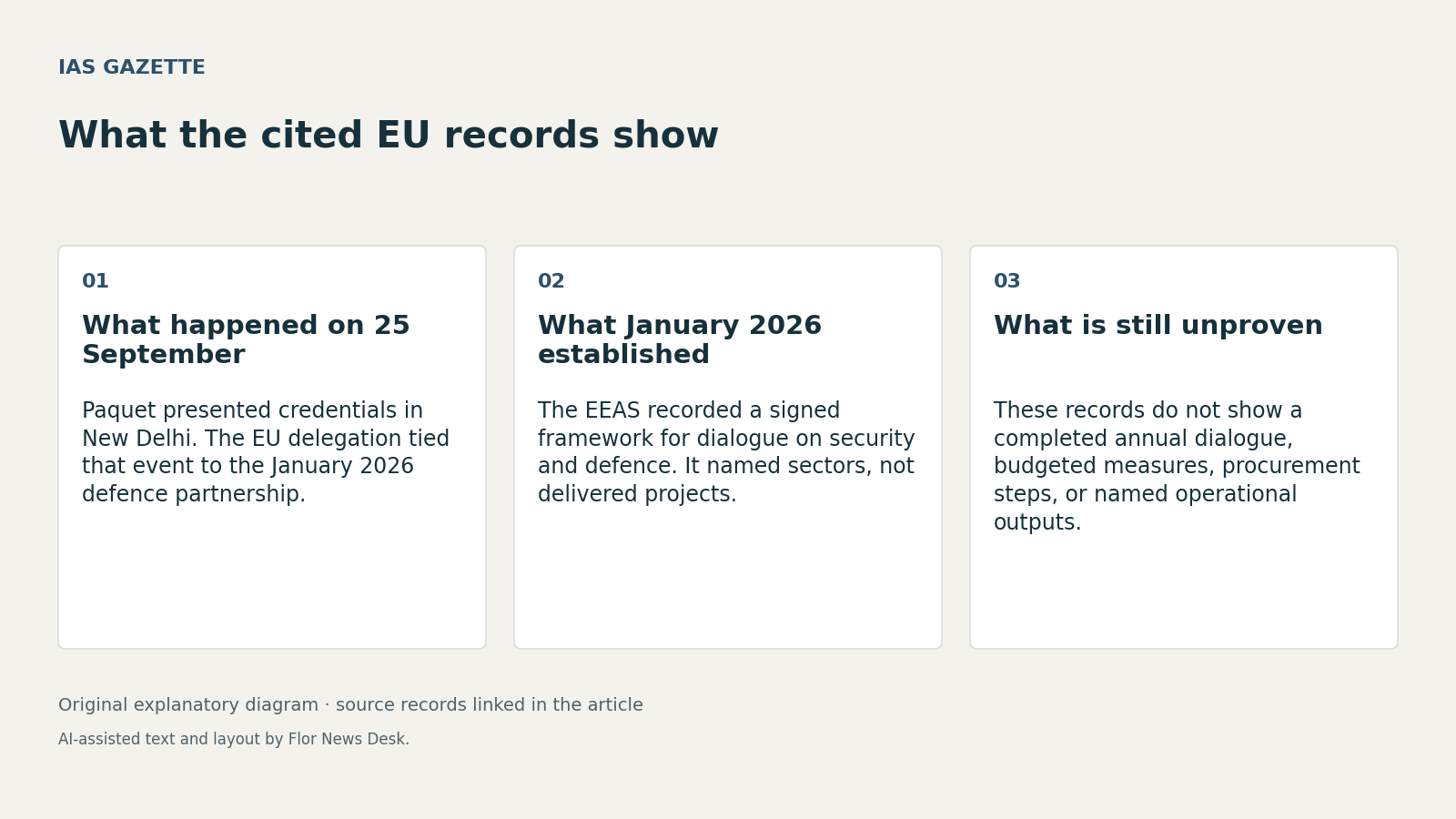
Jean-Eric Paquet’s presentation of his letters of credence in New Delhi on 25 September 2026 gave the European Union a fresh diplomatic moment to signal that security ties with India are meant to move beyond summit language. The EU Delegation’s account of the ceremony explicitly connected his accreditation to the EU-India Security and Defence Partnership signed on 27 January 2026, framing the ambassador’s arrival as part of a broader security agenda rather than a routine protocol event (EU Delegation to India release, 25 September 2026).
What the public record establishes is narrower than that political framing. The European External Action Service said on 27 January 2026 that the EU and India had signed a Security and Defence Partnership on the margins of the EU-India Summit, with High Representative/Vice President Kaja Kallas and External Affairs Minister Dr S. Jaishankar as signatories (EEAS announcement, 27 January 2026). According to that EEAS page, the partnership creates a framework for dialogue and cooperation on peace, security and defence, covering maritime security, cyber issues, hybrid threats, counterterrorism, space security, non-proliferation and disarmament, and defence industry-related matters (EEAS announcement, 27 January 2026).
That matters diplomatically because it turns a broad political intent into a named institutional channel. The EEAS record says implementation is to run through an annual EU-India Security and Defence Dialogue, supported by thematic exchanges and consultations (EEAS announcement, 27 January 2026). The delegation release about Paquet’s credentialing repeated many of the same priority areas, including maritime security, space, cyber and hybrid threats, and counterterrorism (EU Delegation to India release, 25 September 2026). Read together, the two documents show institutional continuity: the January agreement defined the areas of work, and the September credentialing was used to reinforce that agenda in New Delhi.
But the same records do not prove that the partnership has yet been operationalised in the stronger sense often implied by security diplomacy. The January EEAS page described how the partnership would be implemented in future tense. As checked against the current date of 15 October 2026, that wording does not establish that an annual Security and Defence Dialogue has already taken place, produced a communiqué, or launched technical workstreams. Nor do the cited pages show published budgets, procurement arrangements, export-control pathways, memoranda on specific programmes, or named operational projects (EEAS announcement, 27 January 2026; EU Delegation to India release, 25 September 2026).
That distinction is the key analytical point. A signed partnership and a credentialing ceremony can show political prioritisation, while still leaving implementation unproven in the public record. In practice, readers should treat future documentary milestones as the test of whether the framework becomes policy with operational content. Based on the cited EU material, the most probative next signs would be a published output from the annual Security and Defence Dialogue, any technical annexes or joint work plans, and any formal EU or national decisions that translate defence-industry language into authorised measures. Those steps are not evidenced by the records used here.
The September credentialing therefore says more about diplomatic intent than about completed delivery. The Delegation’s background note also pointed back to the older legal architecture, saying the 1994 Co-operation Agreement remains the legislative framework for EU-India cooperation after the 1993 Joint Political Statement (EU Delegation to India release, 25 September 2026). That underlines the incremental nature of the shift: the EU has added a new security framework and elevated it politically, but the public documents cited so far stop at framework, priorities and intended process.
Read our editorial standards or send a correction to the editorial desk.