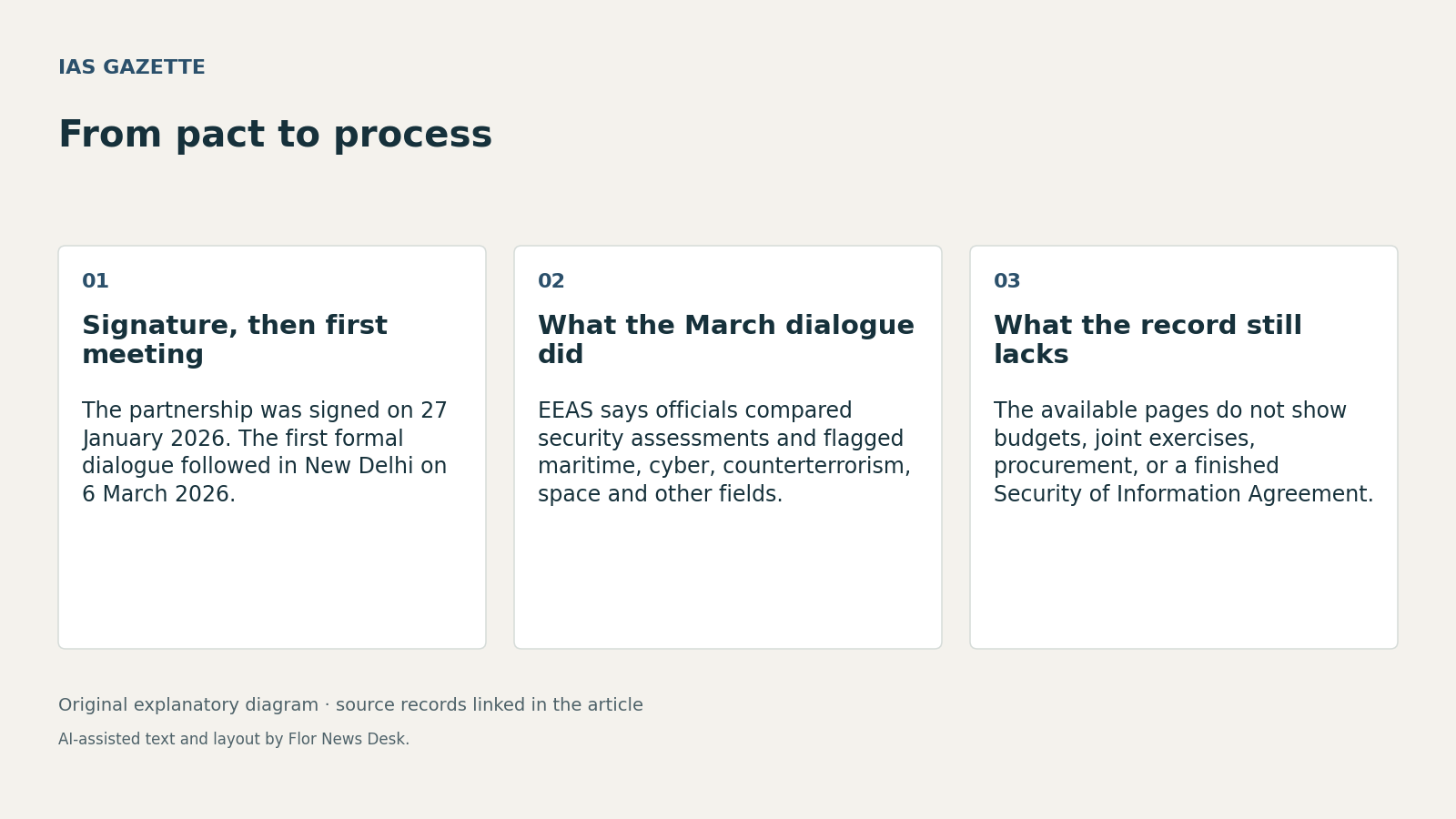
The European Union and India took a measurable step on 6 March 2026 from announcing a security partnership to using it: the European External Action Service says the first EU-India Security and Defence Dialogue met in New Delhi, following the signing of the EU-India Security and Defence Partnership on 27 January 2026. That matters because it is evidence of implementation in process terms. It does not, on the public record used here, prove operational commitments, funding or military deliverables. EEAS dialogue, 6 March 2026 EEAS partnership, 27 January 2026
The institutional change is specific. The EEAS said on 27 January that the new partnership would be carried out through an annual EU-India Security and Defence Dialogue, alongside thematic exchanges and consultations. On 6 March, it then reported that the New Delhi meeting was co-chaired by Benedikta von Seherr-Thoss, Managing Director for Peace, Security and Defence at the European External Action Service, and Dr. Amit Telang, Joint Secretary for International Cooperation at India’s Ministry of Defence. The same EEAS page says the January partnership upgraded annual Security and Defence Consultations into an annual dialogue at managing-director level. EEAS partnership, 27 January 2026 EEAS dialogue, 6 March 2026
The March agenda also helps define what this partnership is. According to the EEAS, the delegations exchanged assessments on Russia’s war of aggression against Ukraine, the Middle East, Iran and the Indo-Pacific, and identified room for more cooperation in maritime security, counterterrorism, cyber, non-proliferation and disarmament, space, and consular matters. Read analytically, that breadth suggests a coordination framework across several security files rather than a single programme with one immediate output. The record shows political consultation and agenda-setting first. EEAS dialogue, 6 March 2026
The most concrete follow-up named so far is narrower: the EEAS says participants discussed next steps on a Security of Information Agreement after negotiations were launched during the EU-India Summit. That is more specific than a general pledge to cooperate, because it identifies a separate negotiation track with a named instrument. But the source record here does not include a text, signature, timetable or entry-into-force detail for that agreement. As of 1 November 2026, these pages therefore show a negotiation under way, not its completion. EEAS dialogue, 6 March 2026 EEAS partnership, 27 January 2026
The January page also places the partnership in a longer trajectory. The EEAS says it builds on India’s participation in joint maritime activities with EUNAVFOR in June 2025, annual Security and Defence Consultations, and a Strategic Dialogue on Foreign and Security Policy launched in June 2025. That context matters because it argues against reading the March meeting as a sudden strategic rupture. A better reading, based on these records, is that Brussels and New Delhi have formalised and elevated an existing set of contacts. EEAS partnership, 27 January 2026
What remains unproven is just as important as what is now documented. The EEAS pages do not establish joint exercises under the new partnership, defence procurement, budget lines, force-sharing, or completed legal arrangements for sensitive information. They also do not measure outcomes in any of the fields discussed in March. For IAS Gazette readers, the next material milestones are therefore documentary: a published or signed Security of Information Agreement, a work programme tied to the annual dialogue, or records of specific joint projects. Until such evidence appears, the story is early institutional operationalisation, not yet demonstrated defence integration. EEAS dialogue, 6 March 2026 EEAS partnership, 27 January 2026
Read our editorial standards or send a correction to the editorial desk.