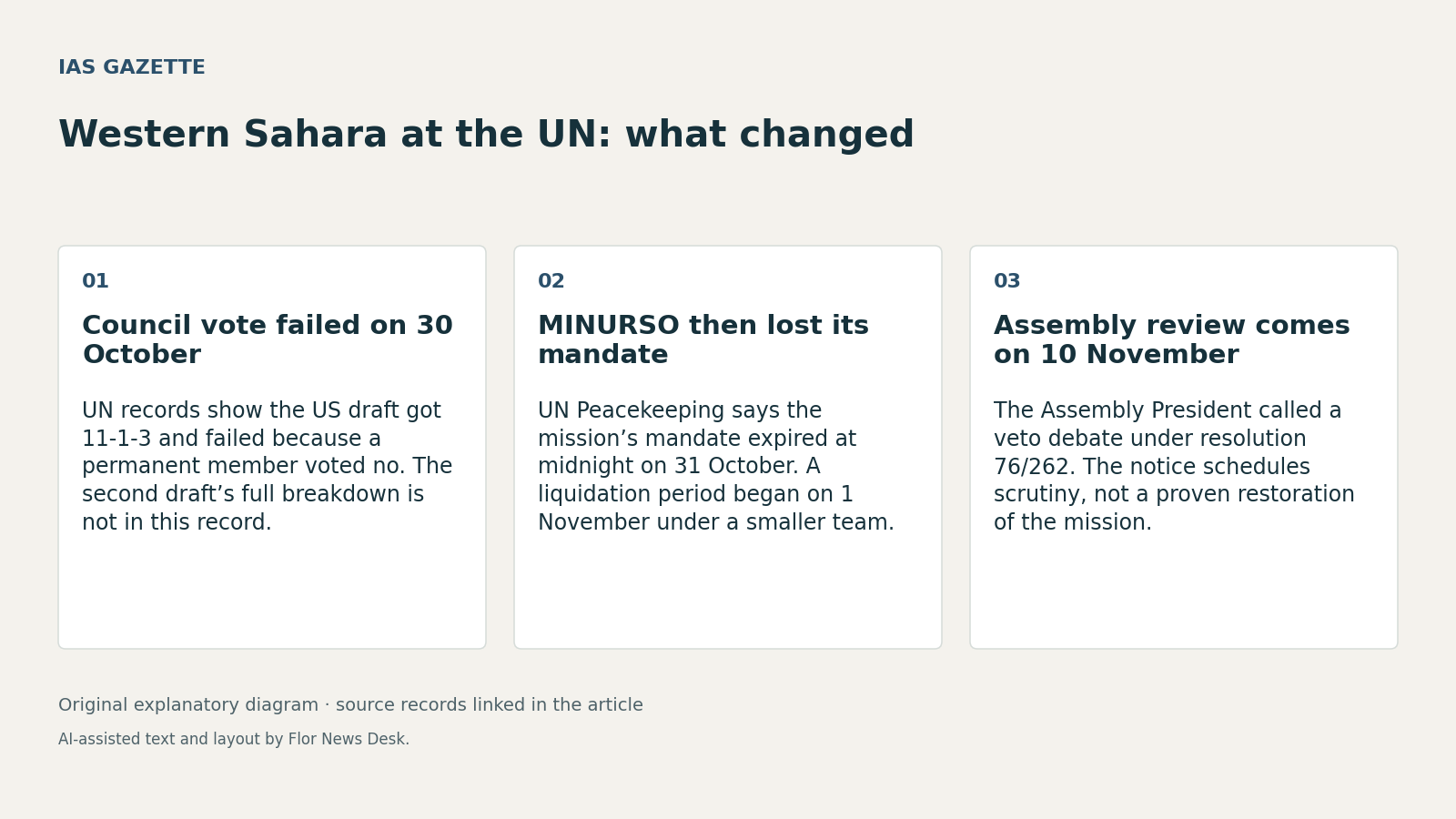
The immediate change is procedural but consequential: the President of the General Assembly has convened a plenary meeting for 10 November 2026 on the “use of the veto” after the Security Council failed to adopt a text on Western Sahara on 30 October 2026 and MINURSO’s mandate then expired at midnight on 31 October 2026, according to a 2 November letter from the Office of the President of the General Assembly and a 1 November UN Peacekeeping update (GA letter; UN Peacekeeping page).
What the public UN record establishes most clearly is the sequence. At the Security Council meeting on 30 October, members had before them the Secretary-General’s report S/2026/781, a 13 October letter S/2026/782, and two draft resolutions, S/2026/868 and S/2026/870. The Council first voted on draft S/2026/868, submitted by the United States, and the chair announced 11 votes in favour, 1 against and 3 abstentions. It was not adopted because a permanent member cast the negative vote (Security Council transcript).
The attribution of that veto is supported by the UN Peacekeeping account, which says Russia vetoed the United States draft and that a Russian alternative text then failed to secure the nine votes required for adoption (UN Peacekeeping page). The transcript also records the Russian Federation saying it had blocked the United States draft and was proposing a concise technical extension (Security Council transcript). But the record remains incomplete in important ways. The transcript page says it is generated by automatic speech recognition and is not an official UN record; it also contains a meeting-number discrepancy, with the page title identifying the 10259th meeting while the spoken opening refers to the 10,260th. The excerpted transcript does not provide the full formal vote breakdown for the second draft (Security Council transcript).
The practical effect, however, is not ambiguous in the UN Peacekeeping summary published on 1 November. It says MINURSO’s mandate expired at midnight on 31 October, that the mission’s operations have ended, and that a liquidation period began on 1 November under a smaller team reporting to the Department of Operational Support. The same page says the Secretary-General’s Personal Envoy, Staffan de Mistura, will continue efforts toward a political solution, and it lists the mission’s then footprint as headquarters in Laayoune, nine team sites and a liaison office in Tindouf, with about 200 civilian staff, military observers and staff officers from more than 35 countries (UN Peacekeeping page).
That is why the 10 November Assembly meeting matters, even if its limits are equally clear. The President’s 2 November letter says he is acting under General Assembly resolution 76/262 and will convene a plenary under agenda item 62, “use of the veto,” because a permanent member cast a veto at the 30 October Council meeting on Western Sahara (GA letter). On this record, that is a forum for member states to examine and politically contest the veto. It is not, in the documents cited here, a mission-renewal instrument or a substitute for Security Council agreement.
The near-term test is therefore documentary as much as diplomatic. By 4 November 2026, there is evidence of a failed Council vote, a lapsed mission mandate and a scheduled Assembly debate. There is not yet evidence in these sources of the Assembly’s eventual stance, any new Council compromise text, or how quickly liquidation and residual UN functions will proceed in practice. Readers should treat the 10 November plenary as the next formal checkpoint, not as proof that MINURSO’s status is about to be reversed (GA letter; UN Peacekeeping page; Security Council transcript).
Read our editorial standards or send a correction to the editorial desk.