The second Thailand–European Union Joint Committee on 29 September 2026 mattered less for a single breakthrough than for the way it pinned broad ties to dated workstreams: an ongoing tenth round of free-trade talks, a security exchange held the previous day, application of the Schengen visa cascade for Thai residents, and a Global Gateway reference tied to flood resilience in the Chao Phraya basin. The same public record also shows why those items should be read as movement toward delivery, not proof that delivery has happened. Joint Committee statement
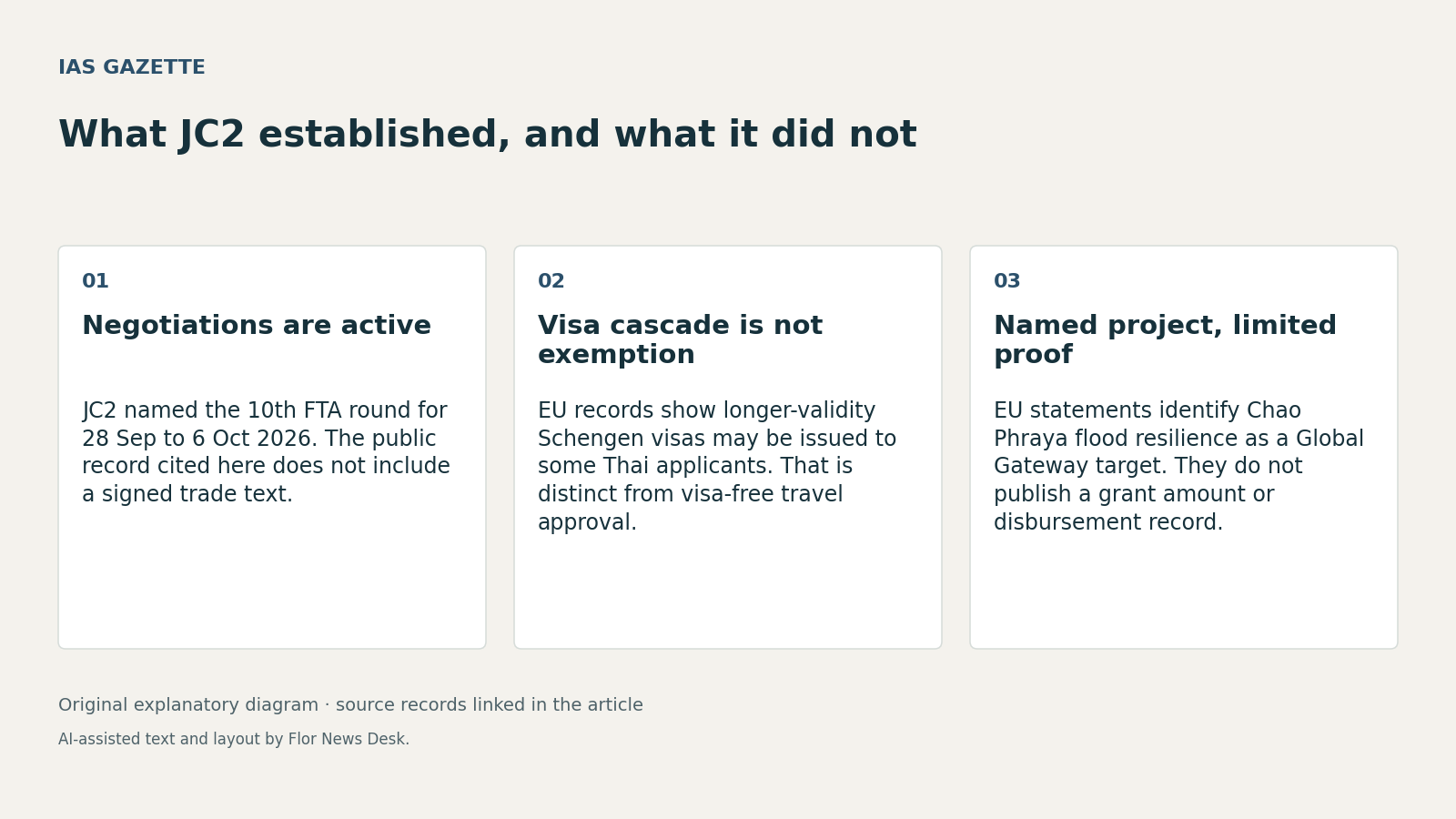
According to the joint statement, the tenth round of EU-Thailand Free Trade Agreement negotiations was running from 28 September to 6 October 2026, and the sides “welcomed progress” in those talks. It also says they reviewed the first meeting of the Specialised Working Group on Trade and Investment, dated 29 June 2026. Those are stronger markers than generic support for future cooperation because they identify a negotiating round already under way and a subsidiary trade body already convened. But the same statement does not provide a negotiated text, say what the tenth round resolved, or document signature or ratification of an agreement. As of 4 November 2026, the cited record therefore establishes process, not conclusion. Joint Committee statement
The security track looks similar. The statement says an EU-Thailand Exchange on Security matters took place on 28 September 2026 and covered maritime security, online scams, hybrid threats and cyber security. Analytically, that narrows the agenda: the relationship is not only about market access or development branding. Still, the document records discussion topics rather than any pact, joint mechanism, or measurable security outcome. For readers assessing whether the EU’s Indo-Pacific language is being operationalised in Southeast Asia, this is evidence of agenda-setting and institutional contact, not yet of an implemented security instrument. Joint Committee statement
Mobility is the clearest case where a concrete EU step and a larger Thai objective should not be conflated. The Joint Committee record says Thailand welcomed the EU decision to apply the Visa Cascade scheme to holders of Thai ordinary passports resident in Thailand, while also expressing interest in Schengen Visa Exemption. A separate EU Delegation page, published on 18 May 2026, explains that the cascade can allow progressively longer-validity multiple-entry short-stay visas for qualifying applicants, but does not create a right to work and does not establish visa-free entry. That distinction matters because the JC2 text records implementation monitoring for the cascade, while visa exemption remained an interest for further discussion rather than an approved outcome. Joint Committee statement Visa cascade explainer
The Global Gateway item also moved from abstraction to a named project, but not to publicly evidenced financing. JC2 says Thailand welcomed Team Europe’s planned investment in the Chao Phraya Flood Prevention project, focused on community resilience and digital water management. On 14 October 2026, the EU, France and Germany separately said they were reaffirming support for Thailand’s Chao Phraya Flood Risk Management Master Plan, with the EU saying it will contribute grant funding and French and German partners describing intended areas of support. Yet that later statement does not publish a grant amount, financing agreement, procurement record or disbursement. The practical reporting test is therefore straightforward: named project, yes; public proof of money contracted or spent, not in these records. Joint Committee statement Flood resilience statement
The institutional backdrop is itself a reminder to separate history from current status. An EEAS page from 2 September 2022 says EU and Thai negotiators initialled the text of a Partnership and Cooperation Agreement after talks resumed in 2021, and that signature and entry into force would come later after internal procedures and ratification. Because that page speaks in future tense as of 2022, it cannot by itself prove the agreement’s status on 4 November 2026. What the 2026 Joint Committee does show is that Brussels and Bangkok are now using a formal bilateral forum to turn political alignment into checkable milestones. The next genuine proof points are not new statements, but published texts, approvals and contracts. 2022 PCA page Joint Committee statement
Read our editorial standards or send a correction to the editorial desk.