

The Asian Development Bank approved a US$650 million equivalent programme for Indonesia on September 16 to strengthen intergovernmental fiscal management. Its significance for residents will depend on how national rules and information systems affect the budgets and decisions of local governments.
The ADB announcement describes the first subprogramme of Accelerating Decentralization for Improved Local Governance, or ADIL. Its objectives include integrating fiscal information, improving transparency and supporting local revenue. ADB says subnational governments manage approximately 35–40 percent of total public spending, including services such as education and health.
That spending share explains why local implementation belongs at the centre of the story. It does not establish that every locality has the same responsibilities, resources or administrative capacity. The programme's national scale should not erase differences that matter when evaluating delivery.
Separate financing from the service it is intended to support
ADB's public-sector financing guide distinguishes investment lending, policy-based support and results-based lending. The categories describe different relationships between financing and the activities or changes it supports. The guide also separates project design, implementation, completion and evaluation.
Those distinctions are useful when reading any development-finance headline. An approval amount cannot be treated automatically as a list of completed local facilities. Establishing the precise financing conditions for this programme requires its own documents; a general guide does not reveal whether a specific condition has been met.
Trace a local decision
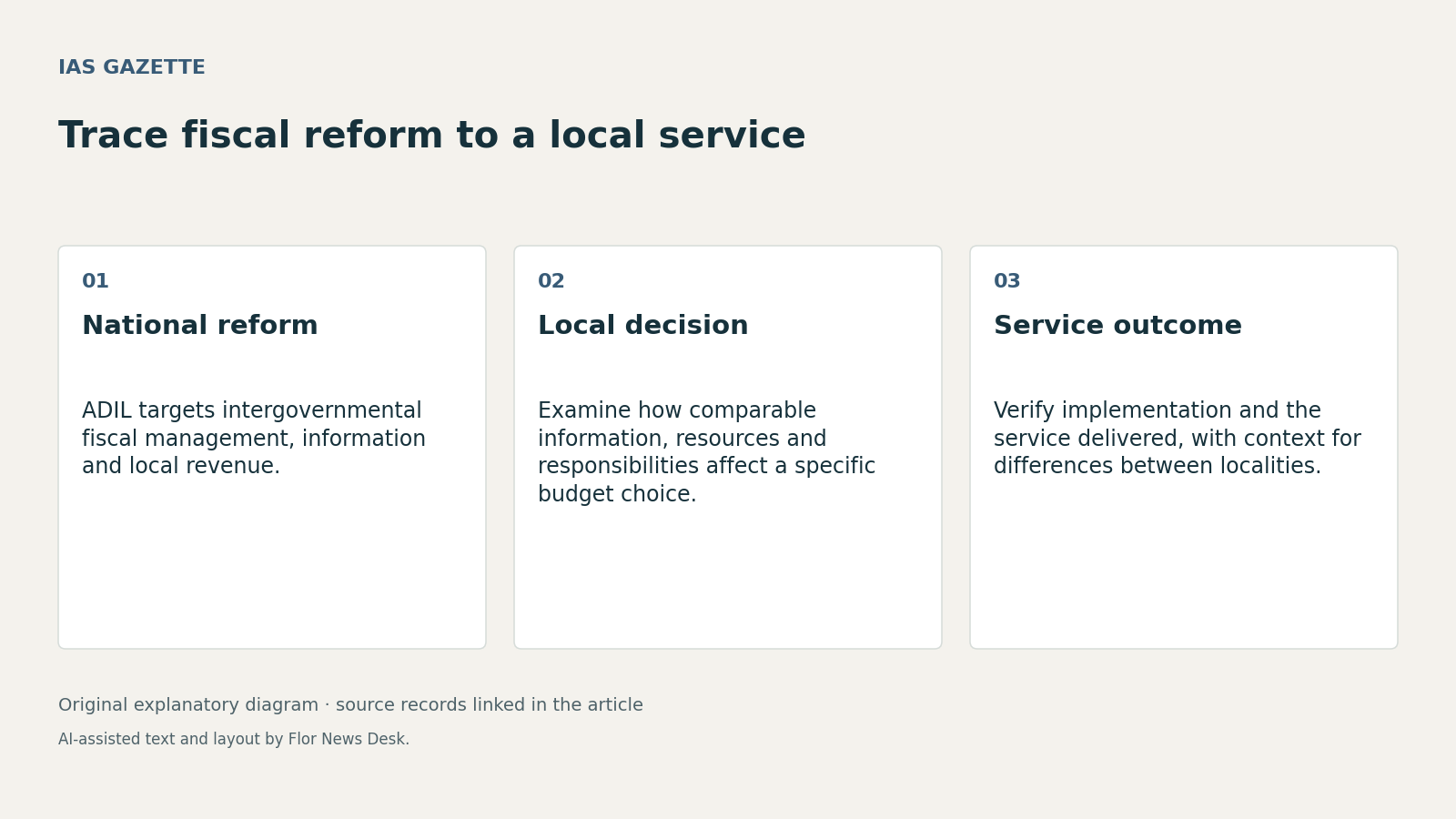
Consider a hypothetical district preparing a maintenance budget for public buildings. A national fiscal platform could make its spending categories easier to compare with those used elsewhere. That would answer a consistency question. It would not alone establish whether the district has enough funding, selected the most urgent repairs or completed the work.
A useful evaluation would follow the decision across those stages. Did officials have comparable information when planning? Was the chosen expenditure funded? Was the work delivered, and did the service remain usable? Each question calls for a different record and a suitable comparison period.
This example does not describe an actual district or an ADIL project requirement. It illustrates the gap between an improved administrative system and the public outcome the system is intended to support. Closing that gap is a matter for implementation evidence.
Compare localities without hiding their differences
A common reporting format can support scrutiny, but a ranking built from it still needs context. A higher spending figure may reflect a larger population, different responsibilities or different costs. A lower figure is not automatically evidence of greater efficiency. The comparison must identify what is being delivered and to whom.
For the same reason, aggregate improvements can conceal uneven experiences. A national report should make its coverage clear and identify where data are missing. That would allow readers to distinguish documented progress from places that have not yet been assessed.
The September approval gives the reform a concrete financial scale and institutional purpose. Its public-service significance will become clearer when national reporting can be connected to specific local decisions and verified outcomes, with the differences between financing, administration and delivery kept visible.
Read our editorial standards or send a correction to the editorial desk.