South Asian education ministries face a planning problem that national population totals can conceal: the number of children may fall while the demand for particular classrooms, teachers and subjects changes unevenly. A September 15 World Bank discussion makes the case for using demographic change to improve schooling. Reading it alongside the underlying research shows why a budget decision needs more detail than a regional headline.
The September discussion highlights Bangladesh, Bhutan, India, the Maldives, Nepal and Sri Lanka. It reports an under-15 projection falling from 420 million in 2024 to 352 million in 2050. Those figures describe a population scenario over a long horizon. They are not an estimate of next year’s enrolment or a recommendation to reduce every school’s budget by the same proportion.
Match the population to the decision
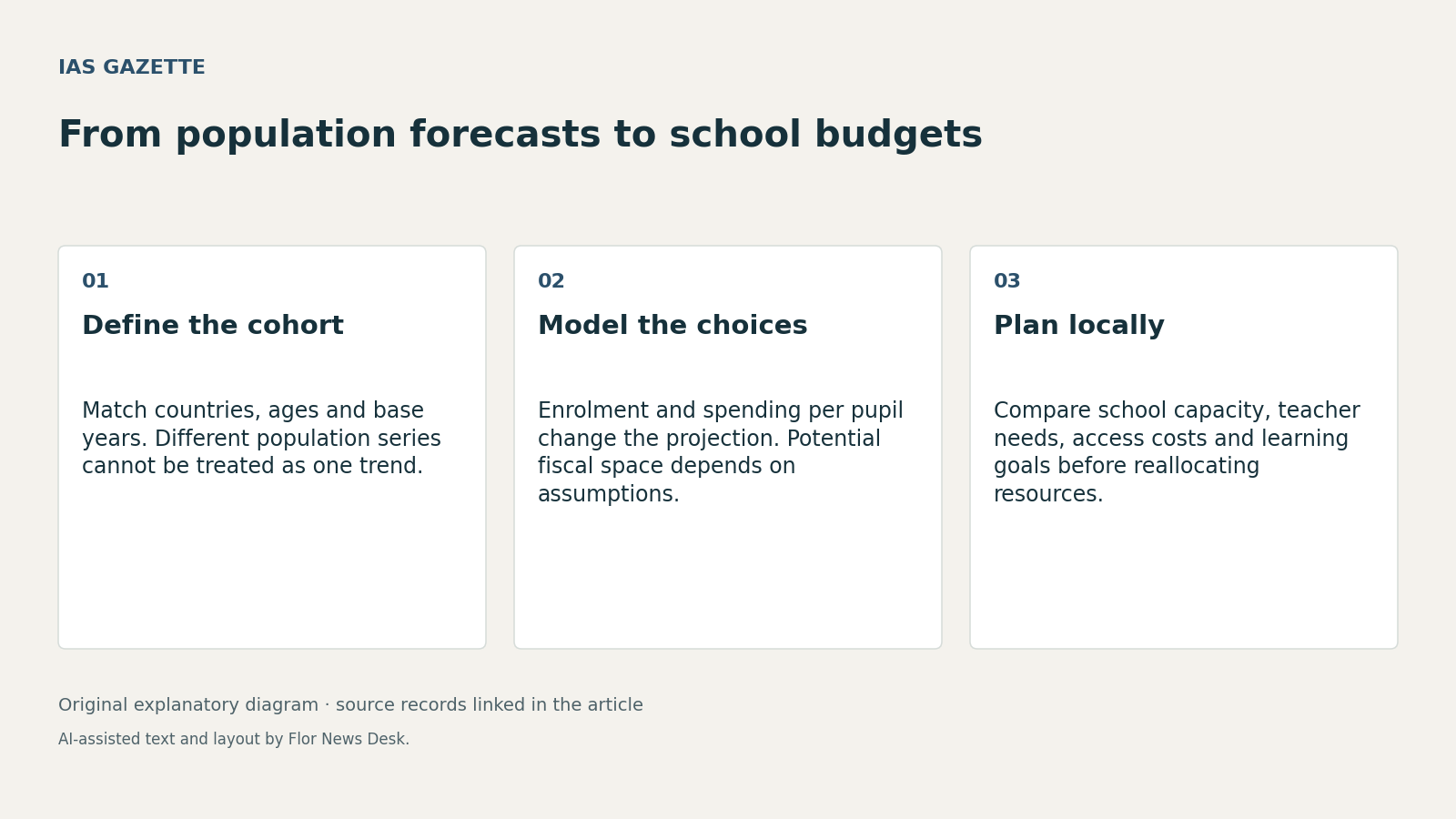
The underlying February 2026 working paper examines eight countries, including Afghanistan and Pakistan. Its introduction uses a different age group and starting year, projecting the region’s under-17 population from 634 million in 2020 to 572 million in 2050. It expects growth in Afghanistan and Pakistan alongside declines elsewhere. Those totals should not be spliced into the newer discussion as if they formed one continuous series. Working paper, introduction
For a ministry, the relevant unit might be children entering primary school in a particular district. For a university, it could be the number completing secondary education and seeking further study. A regional count of younger children cannot answer both questions.
Migration within a country can further separate national trends from local demand. A falling national cohort could coexist with crowded schools in a growing town. That possibility needs local evidence before it becomes an argument for moving staff or closing buildings.
Separate a scenario from an available saving
The paper models expenditure using demographic change, enrolment and spending per student. One scenario assumes universal enrolment by 2050 and estimates average scope to reinvest the equivalent of 0.6 percentage points of GDP in basic education, compared with 2020. The authors also acknowledge that their simplified framework does not capture every economy-wide adjustment.
A numerical illustration shows the policy choice. If a system spent 100 budget units on 100 pupils and later served 90 pupils with the same real budget, spending per pupil would rise from 1 to about 1.11 units. No cash saving has occurred. Whether the additional spending per child improves learning depends on what it buys.
That illustration is arithmetic, not a forecast for any country. It also leaves out differences in student needs, transport costs and subject provision. Those omissions are precisely why an aggregate projection cannot prescribe an individual school’s allocation.
Put a local evidence base beside the forecast
A practical planning exercise would connect projected cohorts to school capacity, teacher specialisms and participation by age. It would show the cost of maintaining access under several options, including the transport and staffing consequences of any consolidation.
It would also specify a learning objective before labelling a reallocation successful. More resources per pupil, shorter journeys and better reading outcomes are distinct measures; progress on one does not establish progress on the others.
The research supplies a reason to plan early. The decision still belongs to a detailed public budget process, with country and district evidence that families can inspect.
Read our editorial standards or send a correction to the editorial desk.