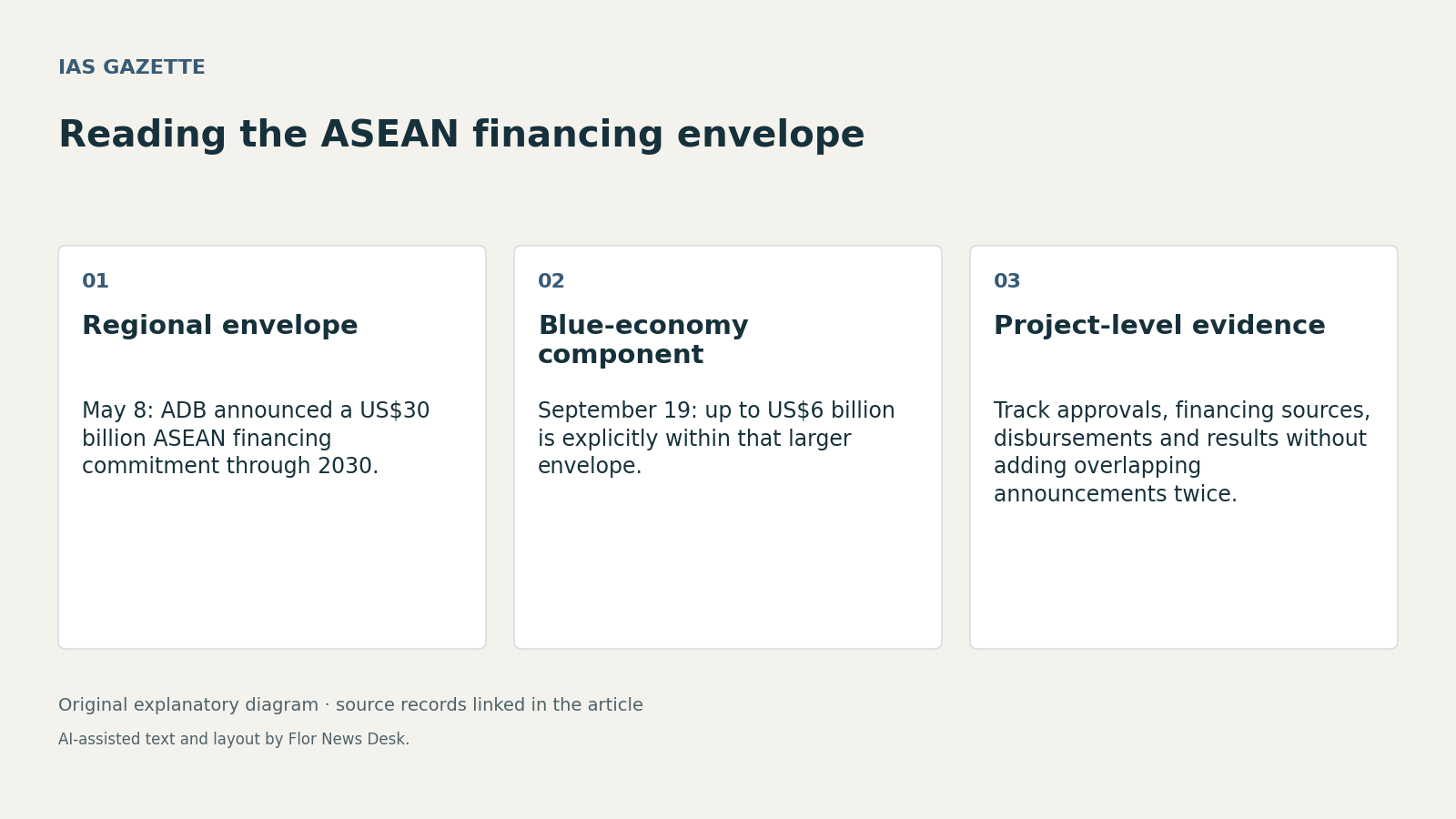
The Asian Development Bank's September 19 commitment to mobilize up to US$6 billion for Southeast Asia's blue economy belongs inside a larger regional financing plan. Reading it as an additional US$6 billion on top of the bank's May announcement would overstate the combined commitment.
ADB's September announcement explicitly places the 2026–2030 initiative within its earlier US$30 billion ASEAN pledge. The initiative covers marine and coastal priorities, including investment foundations, fisheries and coastal infrastructure, and pollution reduction. The bank also identifies upstream water and waste systems as relevant because pollution can reach the sea from inland.
One envelope, several policy purposes
The May 8 announcement describes the wider commitment as a pipeline of public and private investment supporting ASEAN priorities through 2030. It includes capital markets, electricity-grid integration, artificial-intelligence readiness, the blue economy and river resilience. September's announcement gives one part of that programme a defined ceiling and period.
The arithmetic is straightforward, but the reporting consequence matters. If a hypothetical development programme contains a US$100 million total and a later release identifies US$20 million for coastal work within it, the combined total stays US$100 million. A more specific allocation can be newsworthy without increasing the overall envelope.
The same principle applies when one investment serves several purposes. A wastewater project might support public health and marine protection. Describing those benefits separately is useful; counting the project's full financing twice in a consolidated total would be misleading. The September release does not provide the project-level accounting needed to assess such overlaps across the whole ASEAN programme.
Follow the investment chain
Mobilizing finance describes an objective. A project approval, financing agreement, disbursement and completed facility each answers a later question. The September announcement alone cannot establish how much money has already reached an operator or how much environmental improvement has occurred.
For a proposed coastal project, a useful reporting chain would connect its identity, financing sources, implementation dates and measured results. The sources should distinguish the bank's own financing from co-financing where both are present. The result measure should match the project: a waste-treatment facility and a fisheries-management programme should not be reduced to an interchangeable count of projects launched.
These are analytical tests for future reporting, not requirements claimed to appear in an unread financing agreement. They would make it possible to compare successive announcements without losing sight of what each number measures.
The regional promise needs local evidence
An ASEAN-wide initiative raises a distribution question as well as a total-value question. Which places and activities receive approved projects? Which costs and benefits fall on coastal communities, and which arise upstream? A single regional ceiling cannot answer those questions.
September's contribution to the public record is therefore specific: it identifies the scale, period and priorities of a blue-economy initiative already situated within a broader pledge. Its practical significance will become clearer as individual project records connect that regional ambition to financing, implementation and environmental outcomes.
Read our editorial standards or send a correction to the editorial desk.