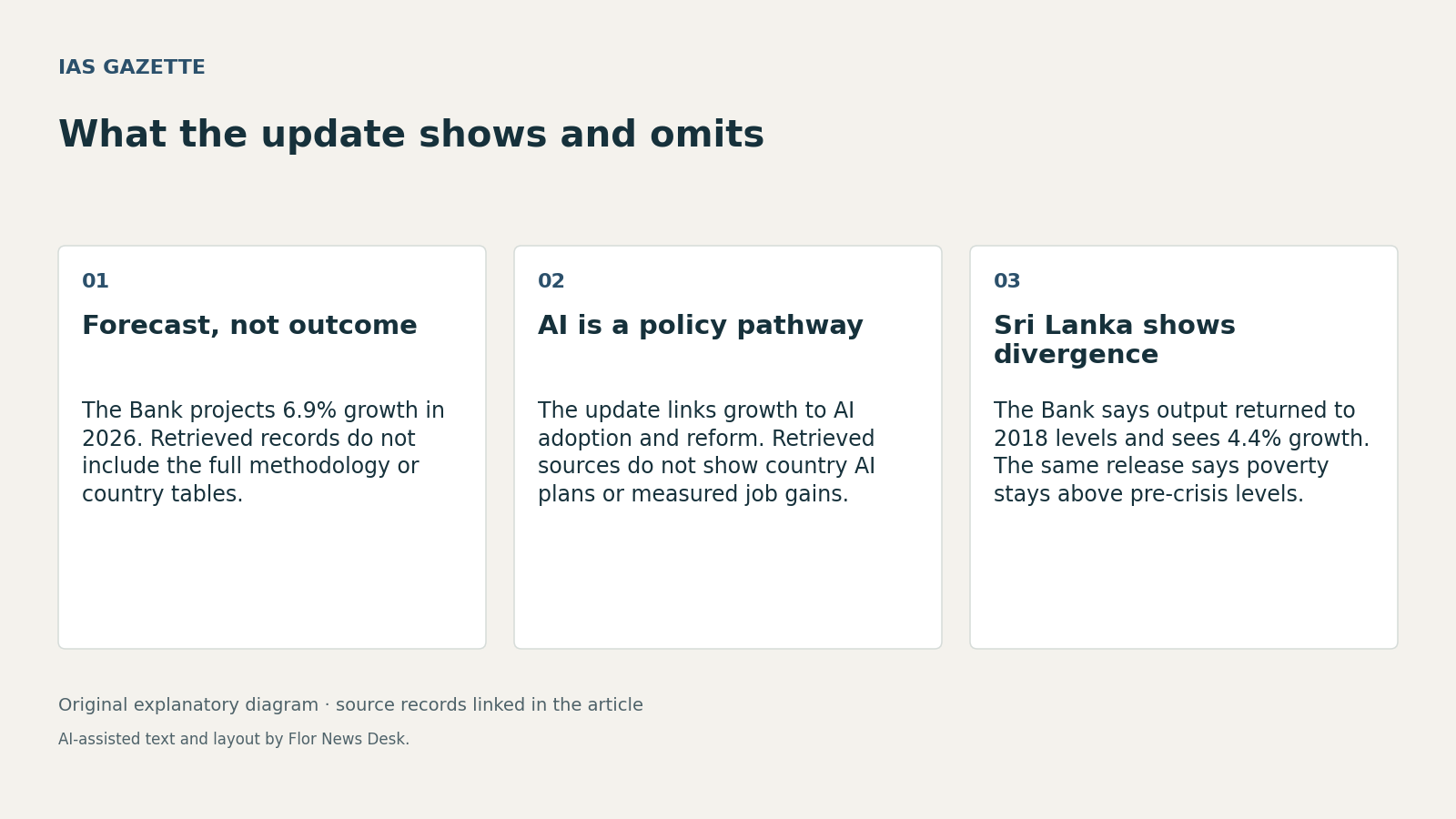
The World Bank put South Asia’s 2026 growth outlook at 6.9% when it released its October 2026 South Asia Economic Update on 6 October, with 6.7% projected for 2027. In the Bank’s account, the forecast rests on strong domestic demand, strong remittance inflows and recent structural reforms, while the main downside risks are elevated energy prices, a severe El Niño episode and a sharp reversal in global AI investment. The publication record confirms the report was posted on 6 October 2026. World Bank press release Document record
What that does not establish is equally important. The retrieved document page is metadata only: it shows the report exists and lists related files, but not the narrative text, forecast tables or methodology. On the record available here, the Bank’s headline should therefore be read as a conditional forecast, not as proof that the region has already secured those growth drivers or insulated itself from the listed risks. That distinction matters for diplomats and policymakers because a forecast can guide negotiation and budgeting without proving implementation or outcome. Document record
The same caution applies to the report’s AI framing. The Bank presents the update under the theme “Adopting AI for Growth,” says AI use is rising in South Asia, and gives one comparison: about 23% of Indian firms use AI against 43% in the United States. It also recommends policy action on skills, infrastructure, business conditions, smaller firms, local innovation and data rules. Those points make AI a clear policy agenda in the Bank’s argument. They do not, on the retrieved record, demonstrate region-wide AI-led productivity gains, country investment plans or tied financing commitments. World Bank press release South Asia regional page
Sri Lanka shows why the regional headline should not be read as uniform recovery. In its Sri Lanka Development Update release, the Bank projected 4.4% GDP growth for 2026 and 4.2% for 2027, said the economy had expanded for 12 consecutive quarters, and reported real GDP up 4.7% in the first half of 2026, with output back to 2018 levels. Yet the same release said poverty remained above pre-crisis levels at 16.9% and again flagged energy-market volatility and possible El Niño effects. The analytical point is straightforward: output recovery and household recovery are not the same claim. The release itself also carries a timing ambiguity, because its URL path shows 2 October 2026 while the retrieved page text is dated 6 October 2026. Sri Lanka release
The Bank’s South Asia landing page adds background, but it also shows why date discipline matters. The page links the October 2026 update while still carrying a separate April 2026 section with labour and climate figures, including 59% employment among working-age people, 32% female labour-force participation, a formal sector around 10% of the workforce, and nearly 48% of the population living in climate hotspots. Those are useful structural context, not proof of October 2026 conditions. They help explain why the Bank pairs an AI adoption argument with climate-risk warnings, but they should not be folded into current-status claims without newer records. South Asia regional page
For readers assessing policy credibility, the practical test now lies outside the forecast headline. The Bank has identified the variables that could validate or undercut its call: remittance strength, reform follow-through, energy exposure, El Niño severity and AI investment momentum. To judge those, later evidence would need to come from budget and policy papers, remittance and balance-of-payments data, national AI strategy releases, and seasonal warning updates that are not contained in the retrieved records. Until those appear, the October update is best treated as a disciplined scenario from a major institution, not a verified regional result. World Bank press release Document record
Read our editorial standards or send a correction to the editorial desk.