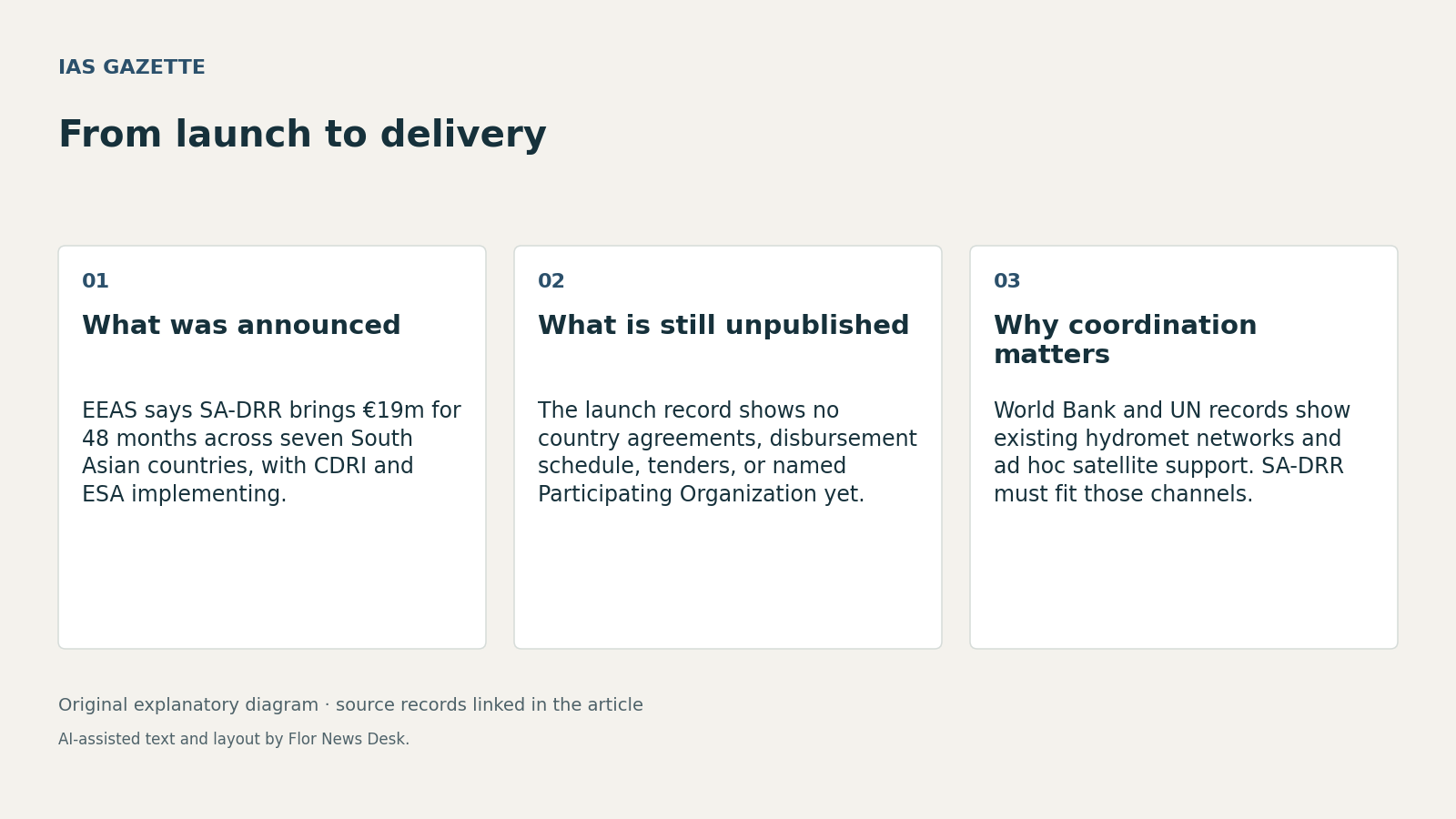
On 7 October 2026, the European Union, the Coalition for Disaster Resilient Infrastructure and the European Space Agency announced a four-year, €19 million South Asia Disaster Risk Reduction programme covering Bangladesh, Bhutan, India, Maldives, Nepal, Pakistan and Sri Lanka. The public record supports a specific conclusion: an idea previously signalled in EU-India cooperation material has become a funded regional initiative. It does not yet show the harder parts of delivery, including country agreements, procurement, disbursement schedules or integration into national warning systems. EEAS launch statement
According to the EEAS statement, the programme, formally titled Support to Disaster Risk Reduction through Earth Observation and Climate Services in South Asia, will run for 48 months and combine two components. One uses CDRI’s Infrastructure Resilience Accelerator Fund and will be carried out by a still-unidentified Participating Organization; the other assigns ESA to focus on the generation, delivery and use of Earth observation and climate services. That structure matters because it spreads responsibility across funding, technical delivery and a regional platform, while leaving key implementation documents unpublished. EEAS launch statement
The institutional history points to continuity rather than a sudden policy turn. A European Union and India development-cooperation page published on 4 August 2021 said the EU already supported CDRI through the Infrastructure for Resilient Island States initiative and described a future South Asia disaster-risk programme in earth observation and remote sensing with ESA. But that page mixes dates and still speaks in future tense, so it is evidence of an earlier expectation, not proof that approval, contracting or implementation had occurred before the 7 October 2026 launch. EU-India development cooperation page
The main governance question is whether SA-DRR adds operational capacity or another coordination layer. The World Bank says the South Asia Hydromet Forum, established in 2018 with support from the World Bank and the World Meteorological Organization, already convenes national hydromet professionals for training, data sharing and weekly virtual exchanges that have run since February 2022. On that record, the EU programme’s distinctive promise is not regional networking alone but better access to Copernicus-derived spatial information and ESA-backed climate services. Whether that becomes routine national practice cannot be established from the announcement itself. World Bank results brief EEAS launch statement
Recent events show why that distinction matters. In a statement published on 11 October 2026 after flooding along Nepal’s Budhi Gandaki River, the United Nations in Nepal said authorities were conducting rapid assessments, FAO Nepal had deployed a LiDAR drone, and OCHA was seeking satellite imagery and analysis through UNOSAT and the International Charter. That is not evidence that SA-DRR will support this response. It does show that, during active disasters, imagery is already sourced through several channels, so any new programme will be judged by how it connects with national agencies rather than by its budget headline alone. UN Nepal statement
Several milestones therefore matter more than the launch event. The EEAS page does not identify the selected Participating Organization for the CDRI-managed component, publish country workplans, or show signed arrangements with the seven governments. It also does not show when EU money will be disbursed or how outputs will connect to meteorological, hydrological and disaster-management authorities. Until those records appear, claims about implementation speed, procurement progress or measurable field impact would go beyond the public evidence. EEAS launch statement
For IAS Gazette readers, the policy change is real but narrower than the announcement’s ambition. The EU has committed funding and chosen CDRI and ESA as joint implementers in a region where resilience diplomacy already overlaps with infrastructure finance, hydromet cooperation and emergency-response support. The next test is administrative as much as technical: whether a 48-month regional design turns into nationally authorised services that agencies actually use before, during and after disasters. EEAS launch statement EU-India development cooperation page
Read our editorial standards or send a correction to the editorial desk.