
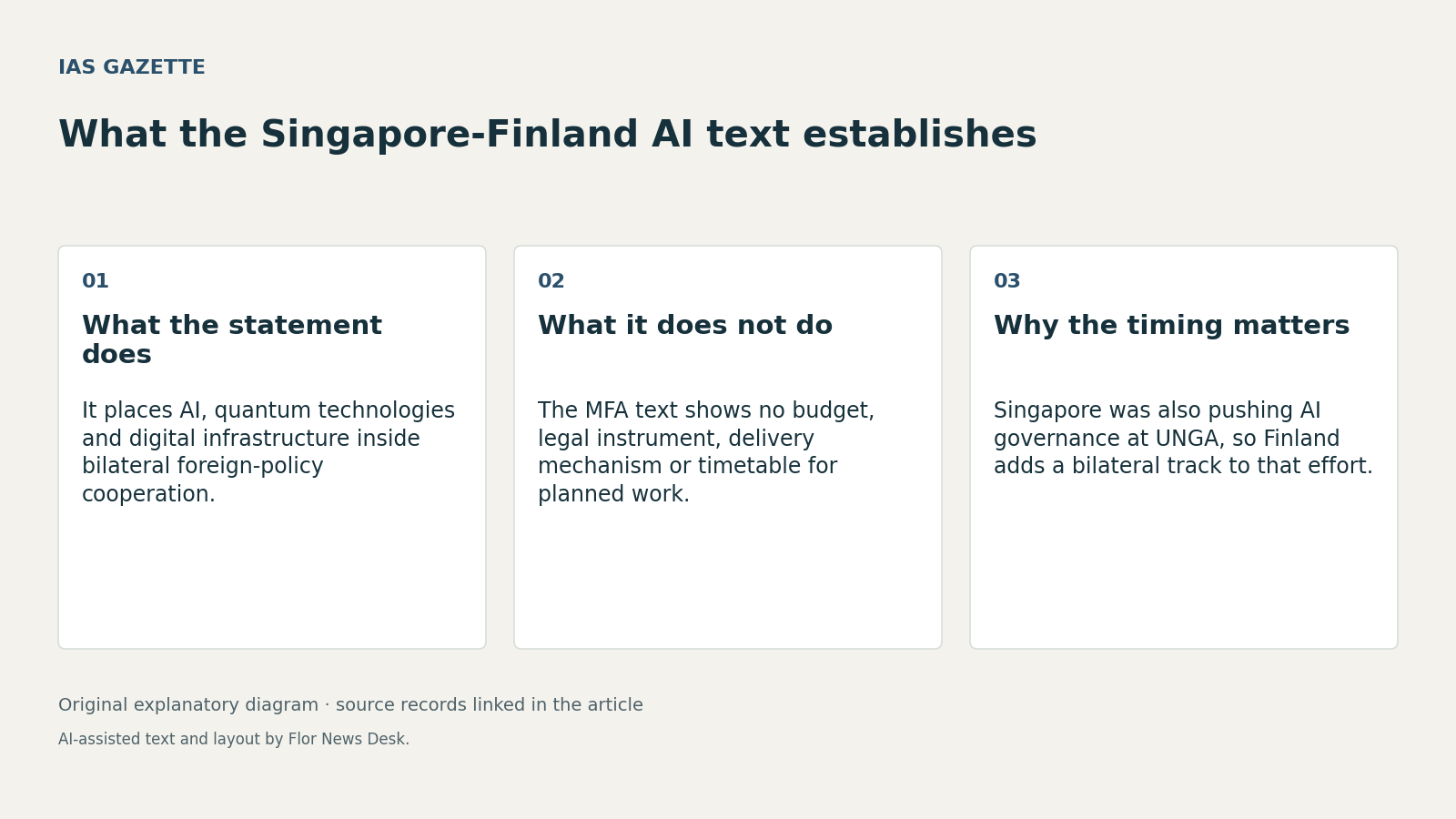
Singapore and Finland have formally added AI to their bilateral foreign-policy agenda, but the public record so far shows a political commitment rather than an operational programme. In a joint statement issued after a 13 October 2026 meeting in Singapore between Foreign Minister Dr Vivian Balakrishnan and Foreign Minister Elina Valtonen, the two governments said future collaboration is expected to focus on AI, quantum technologies and digital infrastructure. The same text does not provide a budget, legal instrument, delivery mechanism or implementation timetable. Joint statement
That matters because the statement is more than ceremonial, but less than a programme launch. It says the two countries intend to work together on international AI governance and links that effort to the Group of Friends on Digital Technologies, which the statement says Finland, Mexico and Singapore established at the United Nations in 2019. It also records that both countries jointly endorsed A Call for Control of Frontier AI Models in September 2026 and intend deeper institutional, commercial and multilateral cooperation on trustworthy, secure and human-centric AI. Joint statement
The Finland text also fits a line Singapore had already been advancing in multilateral settings. In a wrap-up interview during the 81st session of the United Nations General Assembly High Level Week on 26 September 2026, published on 27 September 2026, Balakrishnan said AI had become a major subject of discussion and said Singapore had raised the possibility of considering whether a UN Framework Convention on AI Safeguards is necessary. He also said those discussions were still at an early stage and it was too early to draw conclusions. That is significant for interpreting the Finland statement: the bilateral move sits alongside, not in place of, a still-unsettled multilateral track. UNGA interview transcript
A second Singapore record helps explain the diplomatic logic. At the Milken Institute Asia Summit on 7 October 2026, Balakrishnan described AI and biotechnologies as emerging global commons that will need rules, institutions and international standards. In the same discussion, he argued that Singapore's value in external partnerships depends on consistent law, sanctity of contract and transparency. Read together with the Finland statement, that framing suggests Singapore is trying to make AI cooperation part of its broader trust-based diplomatic offer, rather than treating technology only as an economic sector. Milken Institute Asia Summit transcript
What changed on 13 October 2026, then, is best understood as agenda-setting. The joint statement names future areas of work and anchors them to pre-existing ties, including a 2022 quantum technology memorandum involving Singapore's National Quantum Office, VTT Technical Research Centre of Finland, IQM and CSC IT Center for Science, and a 2026 health-sector MoU covering medical research, health technology and AI. It also places the relationship alongside the EU-Singapore Digital Partnership. But the available text does not show new funding, project selection rules, procurement plans, research calls or a timetable. Joint statement
That gap is analytically important. The statement combines two ambitions that can reinforce each other, but may later require choices: shaping international rules for AI and expanding institutional or commercial cooperation around it. The current record does not say how either side would handle trade-offs if governance preferences, market interests or infrastructure priorities diverge. Nor does it mention export controls, capacity-building commitments or finance. For IAS Gazette readers, the immediate significance is therefore diplomatic rather than operational: Singapore and Finland have signalled that AI now belongs inside their bilateral foreign-policy relationship, while the evidence needed to judge delivery still lies in any later programme documents, budgets or implementation records.
Read our editorial standards or send a correction to the editorial desk.