

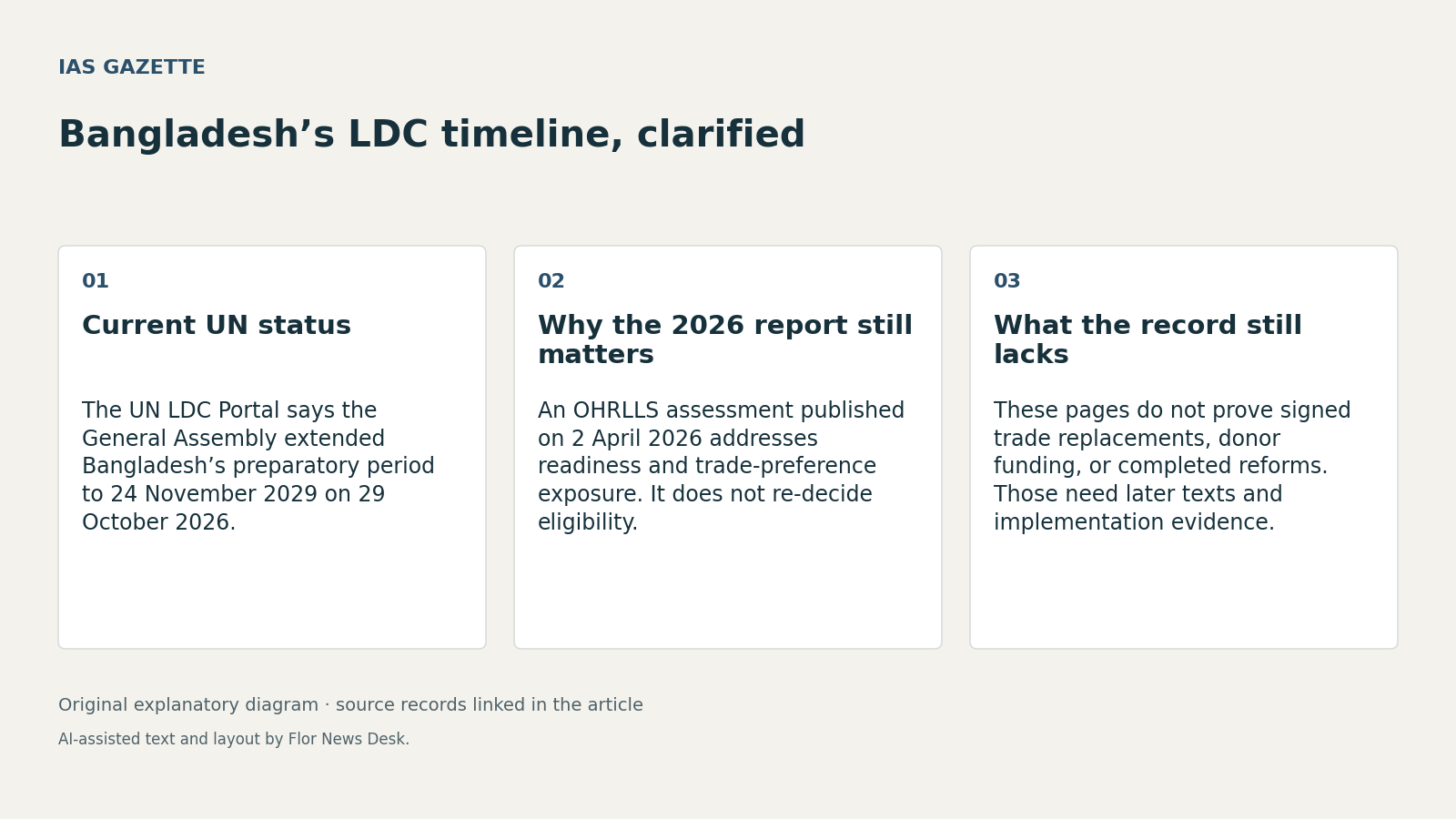
The United Nations now records Bangladesh’s graduation from Least Developed Country status as deferred until 24 November 2029, not 24 November 2026, after a General Assembly resolution adopted on 29 October 2026 extended the preparatory period, according to the UN LDC Portal UN LDC Portal. That is the operative institutional change in the retrieved record, and it means any analysis built around a 24 November 2026 graduation date must be treated with caution.
The same portal says Bangladesh had previously been scheduled to graduate in November 2026, and that the Committee for Development Policy received a request from the Government of Bangladesh on 18 February 2026 to consider an extension under the crisis response provision of the Committee’s enhanced monitoring mechanism UN LDC Portal. The portal further says the Committee concluded that a General Assembly extension would be appropriate if Bangladesh makes significant progress on domestic reforms addressing persistent structural vulnerabilities, and that ECOSOC adopted a decision on 21 July taking note of those conclusions UN LDC Portal. On this source record, the key point is procedural: Bangladesh’s status was not simply left unchanged by inertia; UN organs recorded a request, a Committee conclusion, an ECOSOC step and then a General Assembly extension. What the portal does not provide is the full text needed to assess the precise legal framing of those conditions or any implementation record after 29 October.
That gap matters because a separate UN-OHRLLS page for the “Bangladesh Graduation Readiness Assessment” still says Bangladesh is scheduled to graduate on 24 November 2026 after a five-year preparatory period UN-OHRLLS assessment page. The UN-OHRLLS publications index lists that assessment with a publication date of 02 April 2026 UN-OHRLLS publications index. Read together, those pages suggest the 2026 date on the assessment page is stale wording from before the 29 October extension, not evidence that the extension did not happen.
The readiness assessment still has analytical value, but in a narrower way than some readers may assume. According to the OHRLLS page, Bangladesh exceeded all three graduation criteria in consecutive triennial reviews, and a 2024 assessment confirmed eligibility UN-OHRLLS assessment page. The same page says the assessment examines graduation readiness rather than re-deciding whether Bangladesh meets the criteria UN-OHRLLS assessment page. The institutional distinction is important: eligibility answers whether a country qualifies to leave the LDC category; readiness asks whether the transition can be managed without excessive disruption. An extension of the preparatory period therefore does not, on these records alone, mean Bangladesh ceased to qualify.
The economic sensitivity identified on the OHRLLS page helps explain why that distinction became diplomatically significant. OHRLLS says about three-quarters of Bangladesh’s merchandise exports receive duty-free market access under preferential schemes, and it describes Bangladesh as a large share of the LDC group by population, GDP and merchandise exports UN-OHRLLS assessment page. That supports a cautious reading of the extension: the UN record points to concern about transition management, especially where preferential access and structural vulnerability intersect. But the retrieved pages do not establish what replacement trade terms Bangladesh has secured for 2029, whether donors have formal transition packages in place, or whether the domestic reforms referenced by the portal have been completed. Those are the documents readers should now demand before drawing conclusions about the practical terms of graduation.
Read our editorial standards or send a correction to the editorial desk.