
Sri Lanka and the World Bank Group said on 30 October 2026 that they had launched a Sri Lanka AgriConnect Joint Implementation Plan with the International Fund for Agricultural Development, a move the World Bank described as making Sri Lanka the first country in South Asia to officially join AgriConnect. The same release attached three headline figures to that step: $550 million in World Bank Group investments, $115 million from IFAD, and an ambition to mobilize up to $170 million in private capital over five years, alongside a target of linking 900,000 farmers to agricultural value chains by 2030. World Bank press release
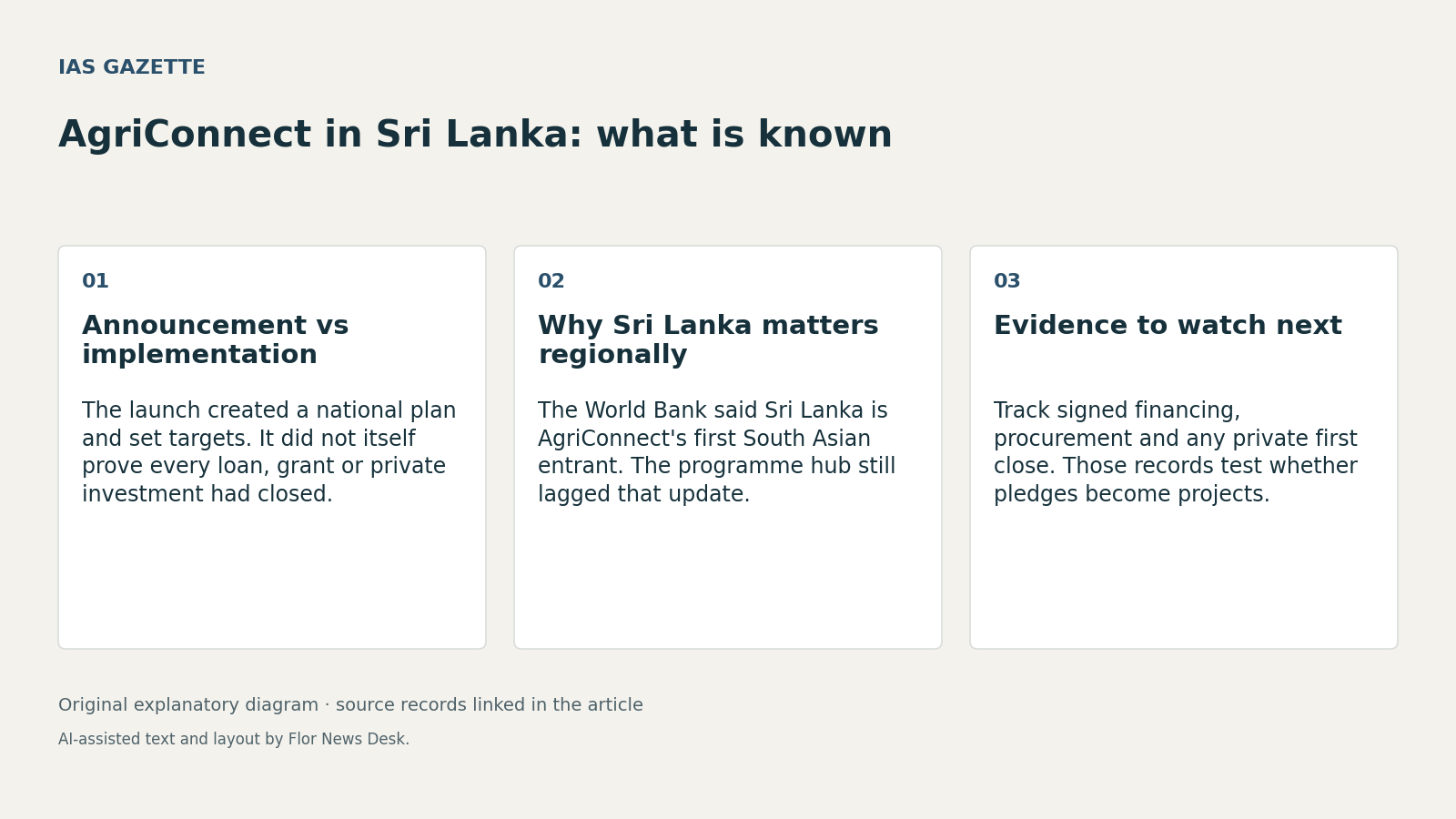
For regional readers, the main change is institutional rather than evidentiary. Sri Lanka now has a named country-level AgriConnect plan tied, according to the World Bank, to Sri Lanka’s Public Investment Programme 2026–2030 and the World Bank Group’s Country Partnership Framework. That makes the launch a clearer policy marker than a generic agriculture initiative. But the same record does not establish signed financing agreements, a disbursement calendar, procurement steps, or private investors reaching a first close. The announcement is therefore strongest as a statement of intended coordination and financing direction, not as proof that the full package is already banked. World Bank press release
The broader programme context matters, but it also shows why date discipline is important. The AgriConnect overview page presents the initiative as a World Bank Group effort to transform farming for 300 million smallholders by 2030, using infrastructure, skills, policy change and capital-mobilization tools including guarantees and insurance. Yet the retrieved version of that page showed no publication date and still listed 13 launched countries without Sri Lanka. That makes it useful for programme design, but not reliable as a complete current roster after the October 2026 Sri Lanka launch. AgriConnect overview
A comparison with Ghana shows how much depends on the document type. In June 2026, the World Bank said Ghana launched an AgriConnect Compact framed as a national platform for coordinated public and private action from 2026 to 2030, with estimated first-phase financing needs of about $3.5 billion and sector targets extending to 2035. Sri Lanka’s October announcement instead highlighted a joint implementation plan with named World Bank Group and IFAD backing. That does not, by itself, prove Sri Lanka is further along. It shows that AgriConnect can be expressed through different national instruments, each carrying different evidentiary weight. Ghana press release
The immediate analytical question is what counts as committed finance. The World Bank’s Sri Lanka release presents the $550 million and $115 million figures as institutional backing, while the private-capital number is explicitly a mobilization goal over five years. Those are not equivalent categories. Public-sector financing may still require project approvals and implementation milestones; private capital depends on transactions that the retrieved records do not identify. The same release says implementation is already under way through the IDA-financed Integrated Rurban Development and Climate Resilience Project and IFC support for cinnamon, coconut and agribusiness finance, but it does not provide measured results from those channels. World Bank press release
That leaves Sri Lanka’s launch as a meaningful regional expansion, but one whose credibility will be decided by follow-through. If the plan is meant to shape the 2026–2030 public investment period, the next useful records are not more launch rhetoric. They are financing agreements, board approvals where relevant, procurement notices, national policy actions tied to the plan, and any disclosed private first close. Until those appear, the strongest evidenced conclusion is narrower: AgriConnect has entered South Asia in formal country-plan form, and the World Bank and IFAD have publicly put their names and target figures behind it. World Bank press release AgriConnect overview
Read our editorial standards or send a correction to the editorial desk.