
The World Bank used a 3 November 2026 press release to turn South Asia’s demographic timetable into a more explicit governance warning. The institution said the region’s working-age population numbers 1.17 billion, will peak in less than a decade, and that South Asia will be an aged regional economy by 2049, meaning 14 percent of its population will be 65 or older. In the Bank’s framing, that raises the urgency of job creation, social protection and health-system planning, not just near-term growth. (https://www.worldbank.org/en/news/press-release/2026/11/03/south-asia-has-a-critical-window-to-turn-demographic-change-into-opportunity)
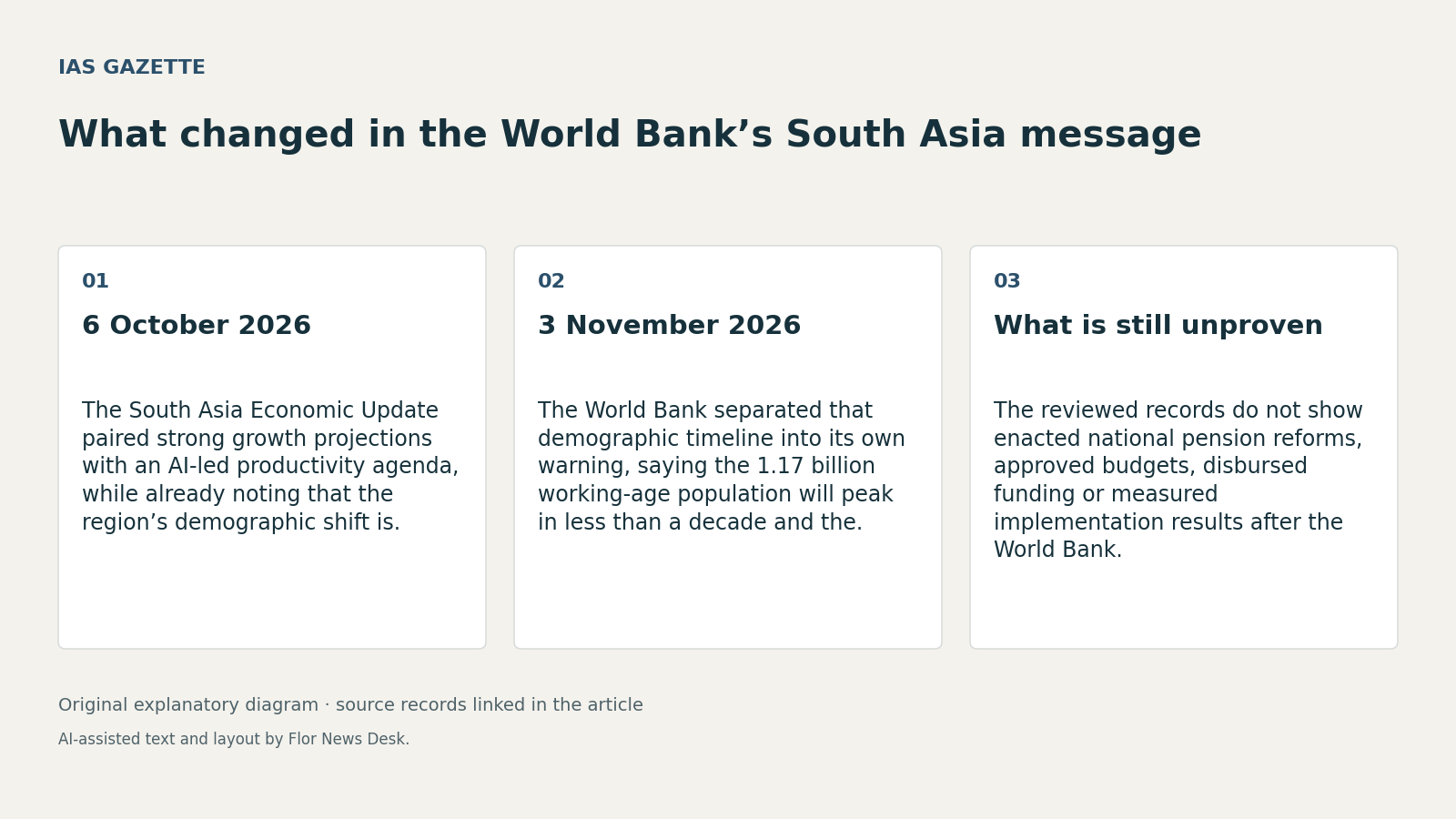
What is new in the public record is the emphasis more than the timeline itself. On 6 October 2026, the World Bank’s South Asia Economic Update page had already published Box 1.1 stating that South Asia’s working-age share peaks around 2034 and that the region turns aged by 2049. A World Bank documents index also shows the October update was web-published on 6 October 2026 and lists related box materials and spreadsheets. That means the 3 November intervention is better read as the Bank elevating an existing projection into a standalone message, not presenting a wholly new demographic chronology. (https://www.worldbank.org/en/region/sar/publication/south-asia-economic-update) (https://thedocs.worldbank.org/en/doc/8ad688ae83bb2966f2ae7f2316431df3-0310012026/)
That shift in institutional emphasis matters because the Bank’s 6 October 2026 growth message looked different. In its press release that day, the Bank said South Asia’s growth was expected to increase to 6.9 percent in 2026 and then slow to 6.7 percent in 2027, supported by domestic demand, remittance inflows and recent structural reforms. It also warned that persistently elevated energy prices, a severe El Niño episode and a sharp reversal in global AI investment could weigh on growth. The update’s subtitle, *Adopting AI for Growth*, highlighted productivity, firms and public-service use of AI. (https://www.worldbank.org/en/news/press-release/2026/10/06/south-asia-s-strong-growth-defies-global-headwinds)
The 3 November release adds a harder demographic deadline to that agenda. According to the World Bank, changes in age structure since 2000 have added 0.4 percentage points to annual GDP growth and 1.1 percentage points to annual labor-productivity growth. But the same release says only 60 percent of the working-age population is employed, and 88 percent of employed workers are informal. It also says only 17 percent of working-age people contribute to a pension scheme, while only 10 percent of older South Asians receive pension benefits. On the Bank’s own evidence, a large labor pool does not automatically become a durable tax, pension or care base when employment remains this informal. (https://www.worldbank.org/en/news/press-release/2026/11/03/south-asia-has-a-critical-window-to-turn-demographic-change-into-opportunity)
The source record also sets clear limits. The October update page says demographic data past 2023 use the medium fertility variant, and it defines aging at 7 percent of the population aged 65 or older and aged at 14 percent. Its chart notes say South Asia’s transition from aging to aged status is 25 years on a population-weighted basis, or 22 years using simple averages. So the 2049 threshold is a projection under stated assumptions, not an observed outcome. (https://www.worldbank.org/en/region/sar/publication/south-asia-economic-update)
As of 5 November 2026, the reviewed record remains almost entirely World Bank material plus World Bank document metadata. It does not establish enacted pension laws, approved budgets, financing disbursements or measured implementation results across South Asia. Nor does it show that governments or other institutions have already shifted the wider policy debate in response to the 3 November release. What it does show is narrower and still useful: the World Bank has moved a demographic warning from an October box into a November headline, and that change in emphasis points readers toward the region’s unresolved jobs and aging-policy gap.
Read our editorial standards or send a correction to the editorial desk.