

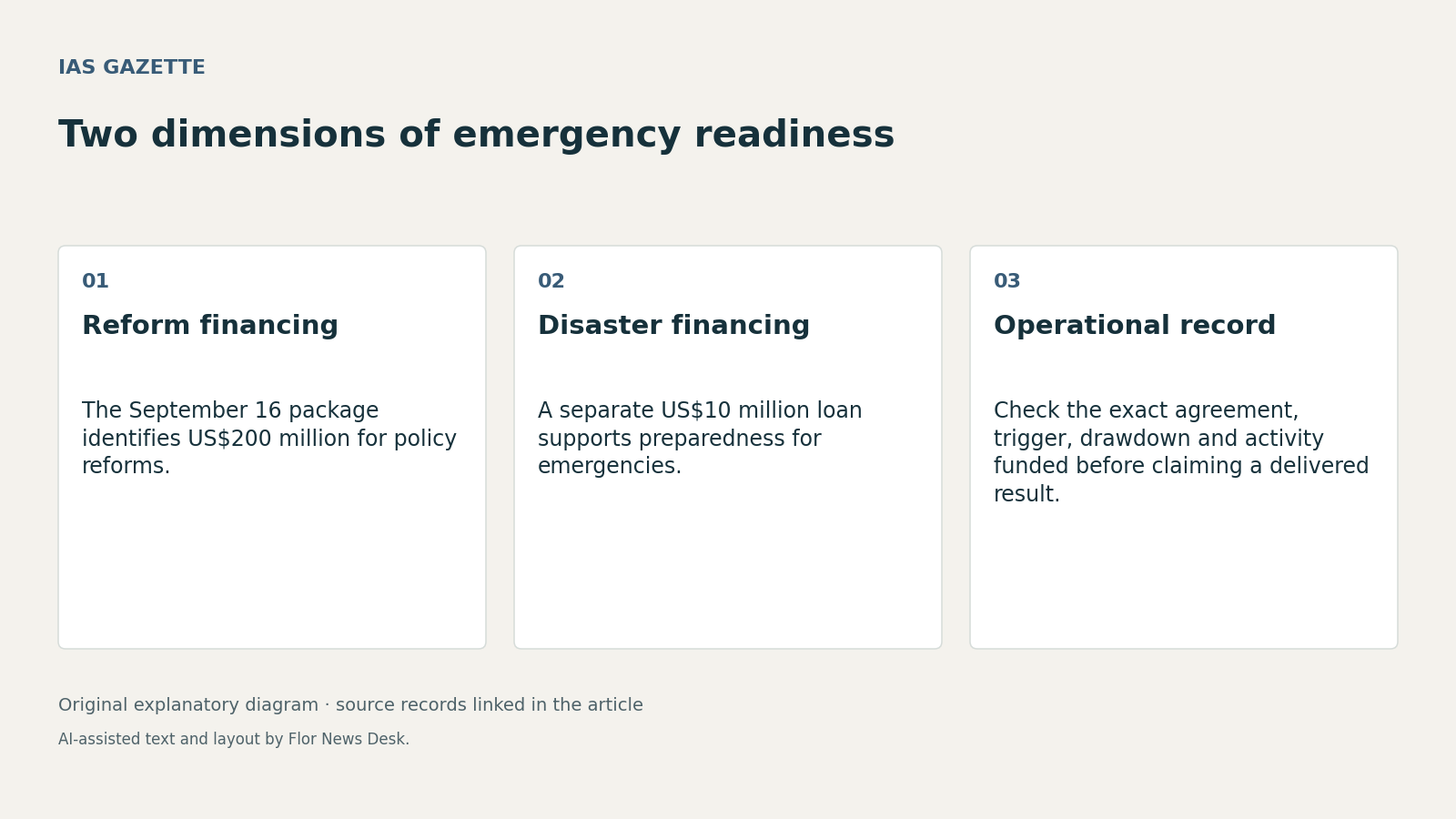
The Asian Development Bank announced a US$210 million package for Fiji on September 16, combining US$200 million for policy reforms with US$10 million for disaster financing. The two components raise different questions about readiness: what the government changes before a shock, and what financing it can access when a qualifying emergency arrives.
The Fiji announcement places the financing in the second phase of a resilience programme. ADB says the package supports areas including access to finance, disaster management, digital transformation and fiscal sustainability. Its stated purposes are forward-looking; the release is not a record that the full amount has already been spent or that the intended results have occurred.
Preparedness and liquidity answer separate needs
ADB's explanation of its wider crisis-response tools describes contingent disaster financing as linking advance reforms with funds that can be drawn when agreed conditions are met. It distinguishes that mechanism from other instruments used for budget support or emergency assistance.
That general description helps frame the Fiji announcement, but it cannot supply the specific conditions in Fiji's financing documents. The country's exact triggers, timing and drawdown arrangements require those records. A regional policy explanation should not be substituted for an individual agreement.
The distinction nevertheless clarifies the logic of preparedness. A government can have a documented response procedure while lacking immediately available cash. It can also receive financing while still facing questions about procurement, distribution or accountability. Readiness has both institutional and financial dimensions, and progress in one does not establish completion of the other.
Follow the trigger through to a service
Consider a hypothetical emergency facility that becomes available after a defined event. A meaningful reporting chain would identify the triggering condition, the decision to draw funds, the amount received and the public activity financed. A statement that the facility exists would answer only the first part of the broader readiness question.
If the facility remains undrawn, that fact alone would not prove failure. The relevant event might not have occurred, or the government might have met its needs another way. Equally, a rapid drawdown would not by itself demonstrate that assistance reached its intended recipients. Both interpretations depend on the agreement and the subsequent operational record.
These examples do not assert what Fiji has done. They identify the evidence needed to examine later claims about the package without confusing available financing with delivered support.
Keep the financing categories visible
The announced US$210 million is composed of loans. Describing it as a grant or as an equal transfer to households would change its meaning. Nor does the combined figure imply that the larger and smaller components are interchangeable sources for any purpose.
For readers following Pacific development policy, the strongest next account would connect the package's precise conditions to implementation milestones and public reporting. The September announcement establishes a financing structure and objectives. Its contribution to resilience will need to be assessed through how those arrangements operate when public services and households face pressure.
Read our editorial standards or send a correction to the editorial desk.