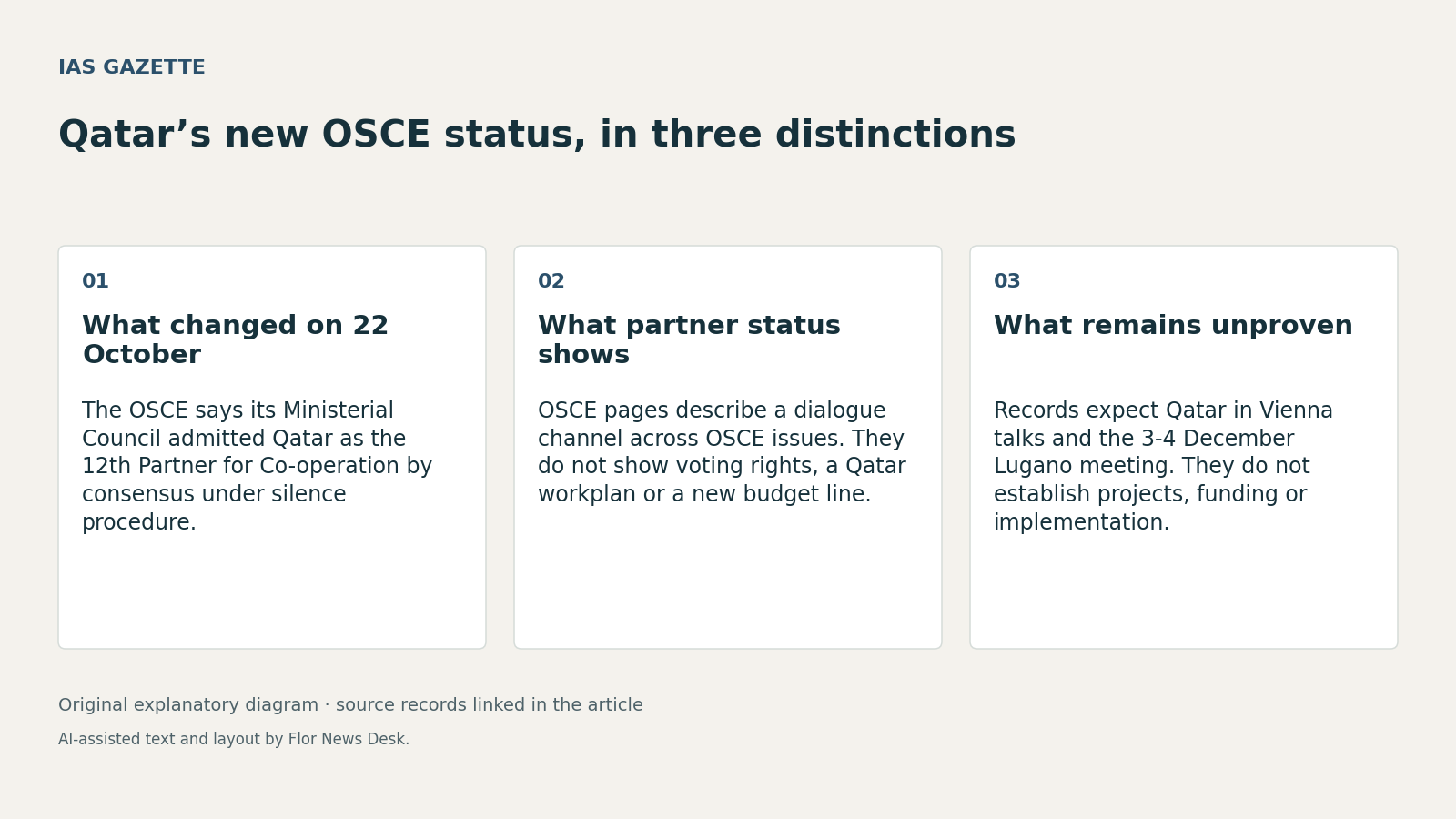
The Organization for Security and Co-operation in Europe said on 22 October 2026 that its Ministerial Council had admitted Qatar as the organisation’s 12th Partner for Co-operation, adding it to the Asian partners category.OSCE release Partners for Co-operation On the evidence now public, that is a meaningful diplomatic widening of the OSCE’s consultative network, but not yet a new operational programme. The available OSCE records show a political opening and expected participation in meetings; they do not establish any Qatar-specific workplan, budget line or signed cooperation package.OSCE release
The institutional setting matters. The OSCE’s partners page says the organisation has privileged relations with 12 Asian and Mediterranean states under the Partners for Co-operation framework, and it now lists Qatar alongside Afghanistan, Australia, Japan, the Republic of Korea and Thailand among the Asian partners.Partners for Co-operation The same page says partner dialogue can cover the full range of OSCE activities. That suggests breadth of agenda, but not depth of commitment. It also underlines a documentation limit: the page mixes evergreen background with dated items and even retains a subheading referring to five Asian partners, despite listing six. That inconsistency makes the page useful for framework, not for proving when each undated element was last revised.Partners for Co-operation
The 22 October release also says the decision was reached by silence procedure and reflected consensus among all 57 participating States.OSCE release Analytically, that means the move appears in the public record as an intergovernmental choice by the OSCE’s membership, not merely a Secretariat initiative. But the same release leaves key terms unstated. In the retrieved text there is no full decision number or text, no Qatar-specific legal detail on rights inside the framework, and no implementation timetable beyond expected meeting participation.OSCE release
That distinction is especially important on money and activity. The partners page says the Partnership Fund, established by Permanent Council Decision No. 812 on 30 November 2007, supports partner activities through extrabudgetary contributions.Partners for Co-operation That shows the OSCE already has a financing mechanism that can involve partners. It does not show that Qatar has been assigned funding, pledged contributions, or agreed projects. Announced institutional capacity is not the same thing as a Qatar allocation, and no such allocation is visible in the retrieved OSCE records.Partners for Co-operation OSCE release
The near-term diplomatic test is also clear, and still prospective. The release says Qatar is expected to join discussions in Vienna and at the OSCE Ministerial Council in Lugano on 3-4 December 2026.OSCE release As of 31 October 2026, those are future milestones rather than evidence of attendance, agenda influence or outcome. The partners page also highlights a 23 October 2026 joint meeting on conflict prevention and preventive diplomacy, showing the OSCE’s wider partner-track activity, but the retrieved record does not tie that event to any concrete Qatar role.Partners for Co-operation
Even the OSCE newsroom architecture reinforces the present limit of the evidence. The retrieved press index is mainly a navigation page, with latest entries on other topics dated 22-26 October 2026 rather than substantive background on Qatar’s admission terms.Press index Because that index view is not a complete archive, it cannot prove that no further record exists. What it does show is that, in the public material retrieved here, the decisive fact is the admission itself. The larger question, still unanswered, is whether Qatar’s new status becomes a recurring forum role, funded cooperation, or mainly a symbolic expansion of the OSCE’s partner map.
Read our editorial standards or send a correction to the editorial desk.