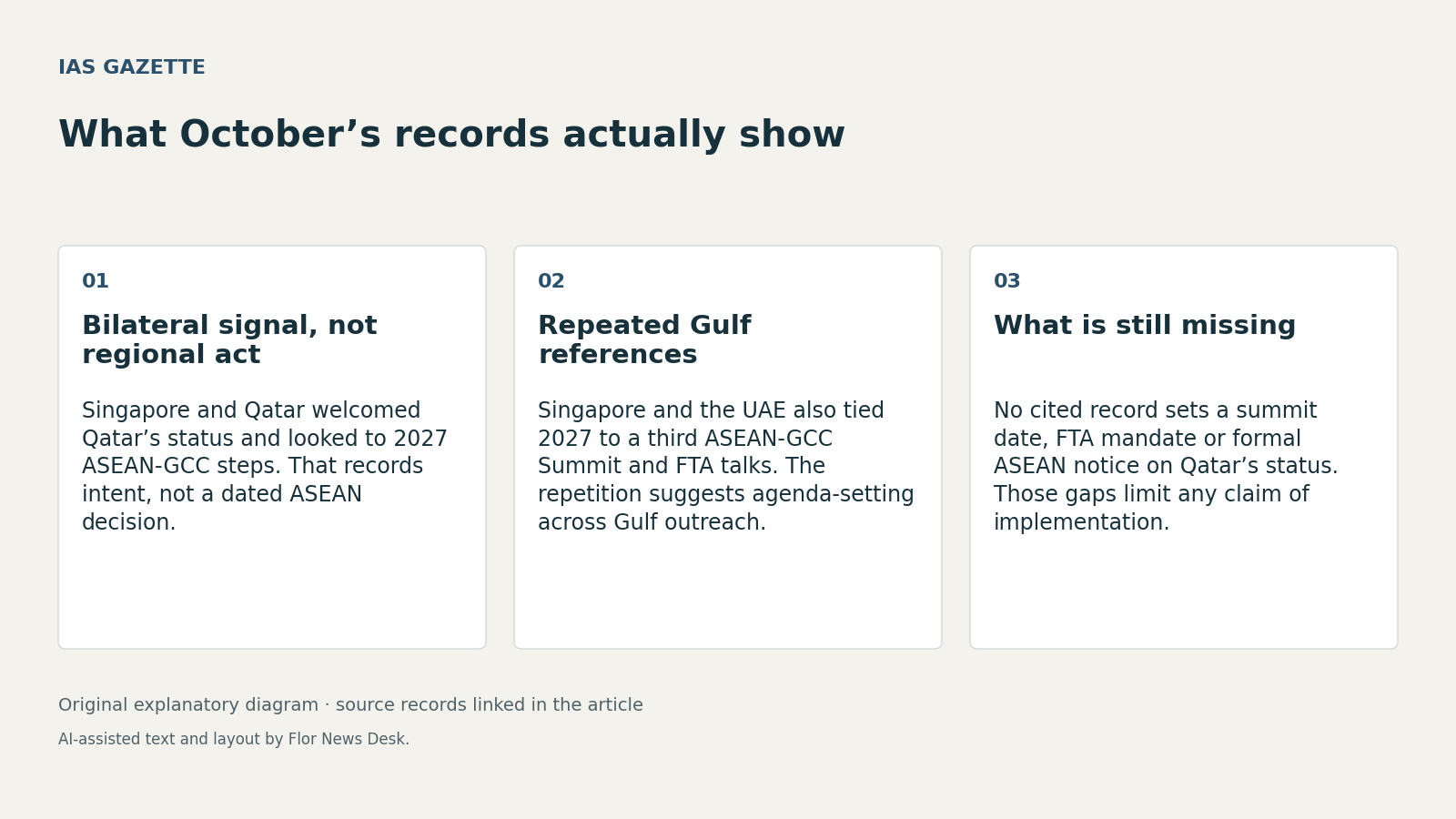
Singapore and Qatar used a 19 October 2026 joint statement to move ASEAN-Gulf diplomacy from general alignment to a named 2027 agenda item. In the annex to Prime Minister Lawrence Wong’s Doha visit, the two governments said they welcomed Qatar’s ASEAN Sectoral Dialogue Partner status and looked to a third ASEAN-GCC Summit and continued efforts toward an ASEAN-GCC Free Trade Agreement during Singapore’s 2027 ASEAN Chairmanship Singapore MFA Qatar visit. As of 29 October 2026, that is a political signal, not evidence that a summit has been scheduled or that a regional trade negotiation has formally begun.
The setting matters because the statement sat inside the ninth Qatar-Singapore High-Level Joint Committee, which Singapore’s Ministry of Foreign Affairs said was co-chaired in Doha on 19 October by Wong and Emir Sheikh Tamim Bin Hamad Al Thani, the first such leader-level co-chairing in the committee’s 20-year history Singapore MFA Qatar visit. The same record says both sides agreed to work toward a Strategic Partnership and that their leaders witnessed the renewal of a QatarEnergy-Singapore memorandum on liquefied natural gas and low-carbon technology. That wider bilateral upgrade helps explain why Singapore would give Qatar a visible place in its broader ASEAN outreach.
The Qatar language was also not an isolated flourish. On 21 October 2026 in Abu Dhabi, Singapore and the United Arab Emirates said they intended to launch negotiations on a Singapore-UAE Comprehensive Economic Partnership Agreement and again pointed to Singapore’s 2027 chairmanship and a third ASEAN-GCC Summit as opportunities to advance cooperation, including discussions on an ASEAN-GCC Free Trade Agreement Singapore MFA UAE visit. The reasonable inference from the two statements together is that Singapore is trying to build a regional Gulf track alongside its bilateral deals.
That reading fits how Singapore was already describing 2027 in multilateral settings. In a 9 October 2026 statement to the UN Second Committee on behalf of ASEAN, deputy permanent representative Karen Ong said ASEAN had concluded negotiations on the ASEAN Digital Economy Framework Agreement, was advancing an ASEAN AI Safety Network, and under Singapore’s 2027 chairmanship aimed to harness AI for inclusive growth, while also advancing energy connectivity through the ASEAN Power Grid Singapore UN mission statement. Read together, the records suggest Singapore is framing its chairmanship as both an internal ASEAN policy programme and an external economic outreach effort.
Still, the evidentiary line is narrow. The Qatar page is a Singapore MFA record with an annexed bilateral statement; it does not itself provide a separate ASEAN Secretariat or GCC record confirming when Qatar obtained Sectoral Dialogue Partner status, nor does it set a date for a third ASEAN-GCC Summit or identify a negotiating mandate for an ASEAN-GCC FTA Singapore MFA Qatar visit. The UAE page similarly records intent and opportunity rather than a regional decision Singapore MFA UAE visit. Those distinctions matter: a welcomed status, a proposed summit and an FTA discussion are different stages.
For readers tracking 2027, the practical question is no longer whether Singapore wants a Gulf agenda. The October 2026 record shows that it does. The open question is whether ASEAN and GCC institutions convert that repeated rhetoric into dated process: a formal notice on Qatar’s partnership status, a summit calendar and published trade scoping or negotiating authority. Until such records appear, the Singapore-Qatar and Singapore-UAE statements show diplomatic prioritisation by national governments, but not yet an implemented ASEAN-GCC package.
Read our editorial standards or send a correction to the editorial desk.