

The European Union announced €150,000 in humanitarian funding on September 18 for communities affected by flooding across Luzon. The announcement identifies a route for assistance through the Red Cross system. It does not yet show when the money moved, how many households received support or whether the planned services reached every intended area.
The EU delegation's notice says the allocation, about PHP10.9 million, is intended to benefit more than 32,000 people in the Ilocos Region, Central Luzon and Metro Manila. The plan covers household and hygiene supplies, meals, drinking water, mobile medical advice, medicine, public-health information and mental-health services.
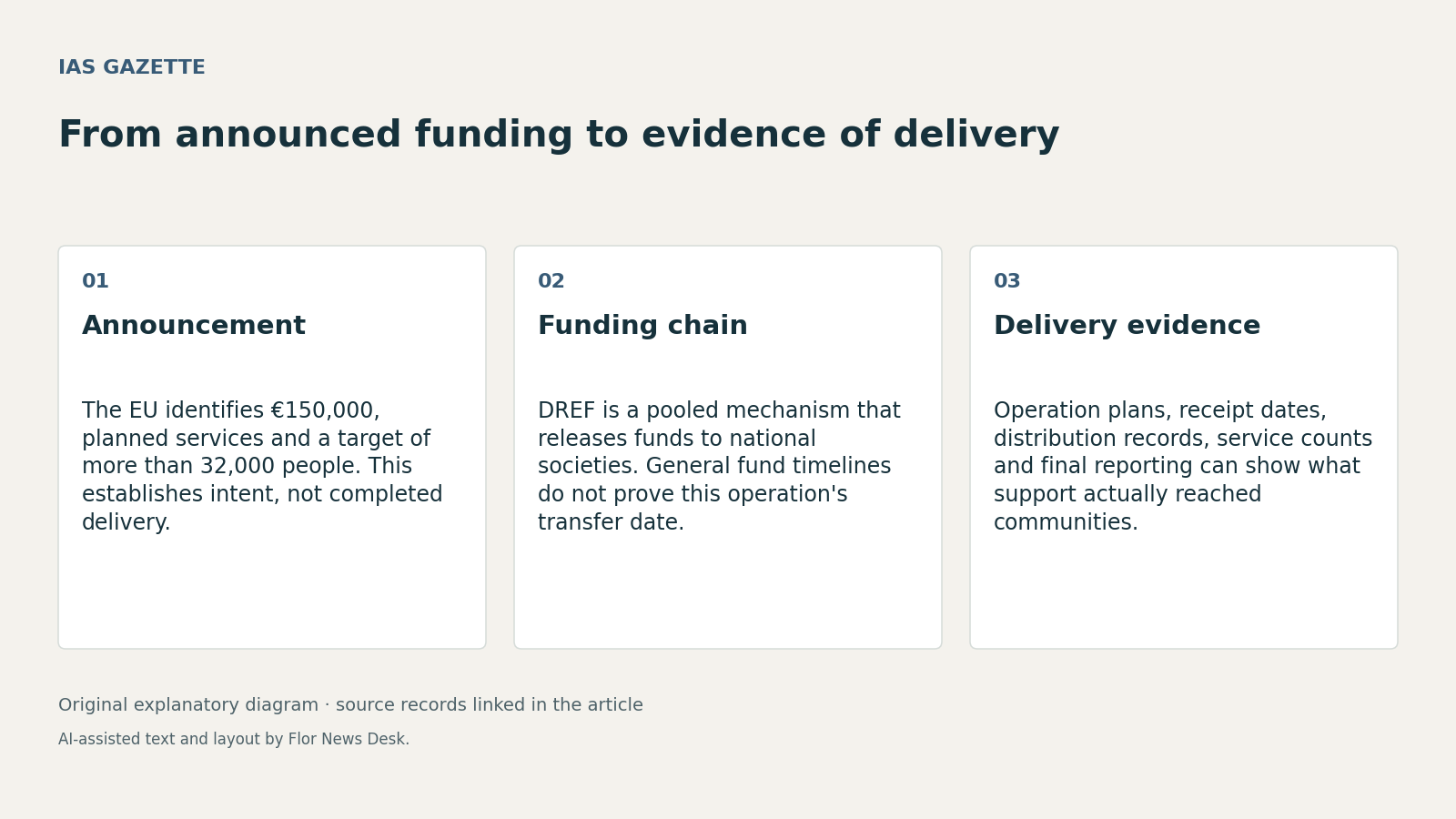
Those are planned uses. The wording matters because an allocation, an operational transfer and a completed distribution are different records. The release says the funding will support the Philippine Red Cross. It does not provide a payment date, an operation number, a distribution ledger or results measured after delivery.
A pooled fund sits between donor and operation
The EU says the grant comes through IFRC-DREF, the federation's emergency pool. The IFRC description of the fund says it can release money to national societies for immediate response and early action.
That structure helps explain why the headline amount should not be treated as cash divided among 32,000 recipients. Supplies, transport, mobile medical teams, water provision and disease monitoring are shared operational services. Dividing €150,000 by the stated beneficiary target would produce a number, but not a documented payment or a meaningful measure of individual assistance.
The same caution applies to the fund's general performance figures. IFRC gives a benchmark of approval within a day and disbursement in fewer than three days. It also says national societies directly receive 82 per cent of DREF resources. Those are descriptions of the global mechanism. They do not establish the approval time, disbursement date or cost structure of this Philippine response.
The need figures and the delivery figures are separate
The EU release places the affected population above 10.5 million in 11 regions as of September 14. It also counts over 120,100 displaced people staying in more than 500 evacuation centres and damage to over 4,500 homes. It attributes the emergency to prolonged monsoon rain intensified by tropical cyclones and other weather systems since early August.
Those figures describe the reported scale of need at a particular date. The target of more than 32,000 people describes the intended reach of this funding. Neither number is a count of people already served. The affected population is also far larger than the grant's stated target, so the announcement should not be presented as financing the entire response.
The release adds that the €150,000 is separate from more than €2 million assigned earlier in 2026 to other humanitarian partners working in the country. Without the underlying programme records, combining those amounts would blur different recipients, dates and purposes.
What would establish delivery
The next useful evidence is operational: a dated DREF allocation or action plan, confirmation of funds received, Philippine Red Cross distribution records, the number and location of mobile-health visits, and a final or interim report comparing planned and delivered support.
Each record answers a different question. A donor announcement establishes an intended contribution. A fund record establishes an operational allocation. Distribution and health-service records establish activity. A post-operation report can then compare targets with results and explain shortfalls.
Until those records are available, the September 18 announcement is meaningful evidence that funding was committed to a defined response. It is not, by itself, proof that the planned assistance has been delivered.
Read our editorial standards or send a correction to the editorial desk.