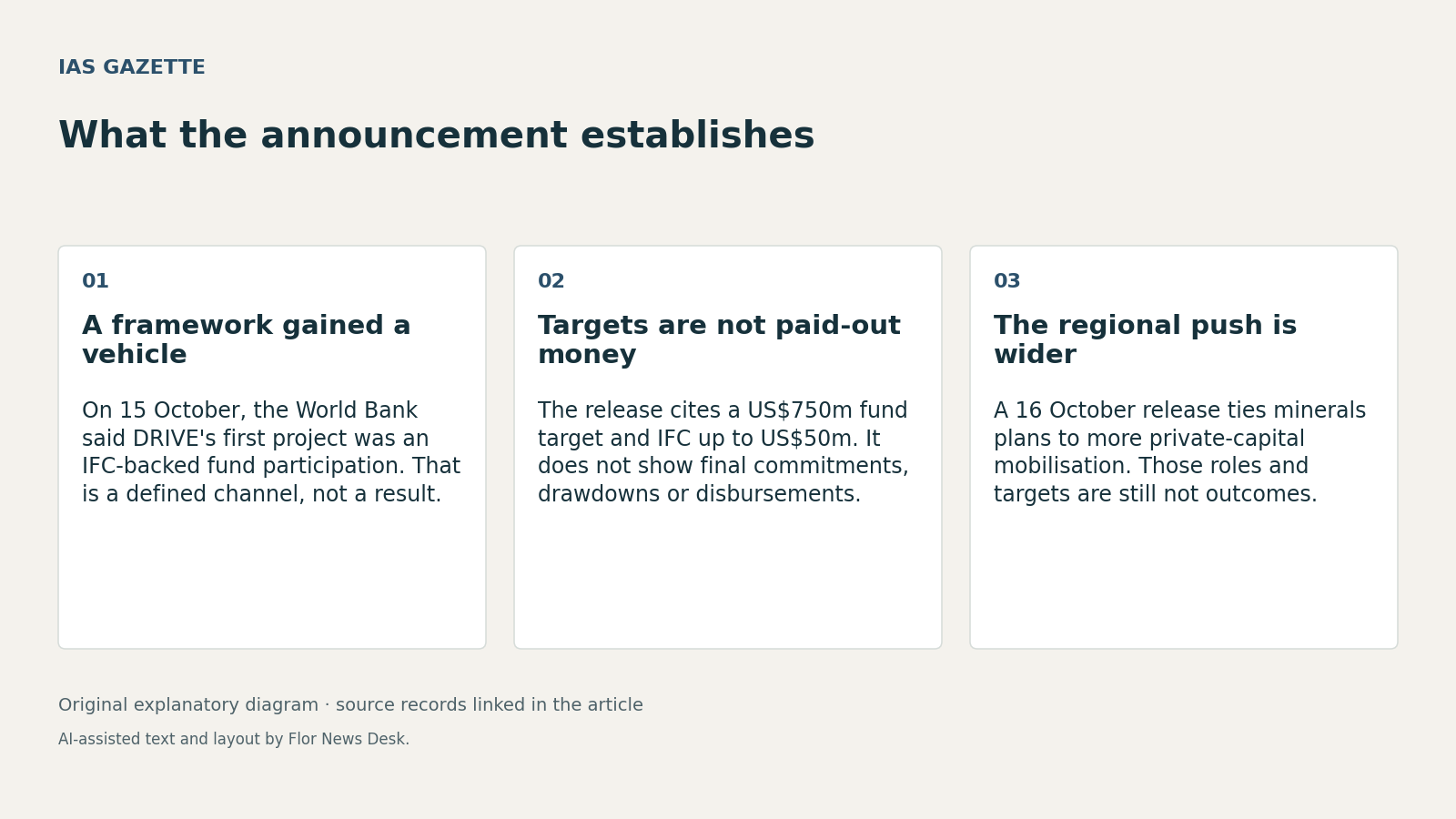
The World Bank Group said on 15 October 2026 that the first project under the Dynamic Response for Invigorating Value Chains and Energy Security, or DRIVE, will be an investment in the Emerging Asia Infrastructure Credit Fund, a privately managed vehicle targeting US$750 million for Southeast and South Asia. In the same release, the institution said the International Finance Corporation will invest up to US$50 million alongside the Japan International Cooperation Agency. That is a concrete institutional step, but it is still an announced financing path rather than demonstrated capital deployment. World Bank Group and Japan Advance Partnership on Energy Resilience in Asia
What changed on 15 October is not that DRIVE suddenly produced measurable project outcomes. It is that the framework moved from a policy label to a named vehicle, named manager and stated investment ceiling. The World Bank Group said DRIVE was launched in June 2026 by President Ajay Banga and Japan’s Finance Minister Katayama Satsuki, and that it complements Japan’s US$10 billion Partnership on Wide Energy and Resources Resilience Asia, or POWERR Asia. The same release said the Emerging Asia Infrastructure Credit Fund was established under a Singapore government initiative and is managed by Global Infrastructure Partners, part of BlackRock. World Bank Group and Japan Advance Partnership on Energy Resilience in Asia
The limits of the record matter as much as the announcement itself. The 15 October release does not say whether IFC or JICA has made a final commitment, signed subscription documents, paid in capital, or drawn down funds. It gives no first-close date, no list of recipient countries, no first portfolio investments, and no published environmental, social, procurement or risk-sharing terms. Readers should therefore resist treating the US$750 million target as money already mobilised, or the IFC figure as money already invested. The source establishes an intended structure, not execution. World Bank Group and Japan Advance Partnership on Energy Resilience in Asia
The broader World Bank messaging from Bangkok suggests why this fund matters politically. On 16 October 2026, the institution said eight governments had launched metals and minerals partnerships and compacts, and it said the World Bank Group planned to increase metals and minerals support fivefold to US$19 billion between fiscal years 2026 and 2030 by combining its own financing with private capital mobilisation. That separate release also divided roles institutionally: the World Bank would provide policy advice and public financing, IFC would invest and mobilise private capital, and MIGA would provide guarantees. The DRIVE fund announcement fits that strategy of using public institutions to crowd in private finance, but the 16 October release is also a plan document, not proof of delivery. Eight Countries Launch Plans to Turn Mineral Resources into Jobs and Economic Growth
There is also a longer World Bank-Japan supply-chain track record, though the source base here is thinner. An undated Extractives Global Programmatic Support news index lists a 23 February 2024 press release on an administration arrangement for the Resilient and Inclusive Supply-chain Enhancement Partnership, which it says had been launched in October 2023, and a 11 October 2023 item on boosting mineral investments and jobs in clean energy. Because that page is only an index and carries no single publication date, it supports continuity of agenda rather than any current implementation claim. Extractives Global Programmatic Support news and events
The clearest analytical reading, then, is narrow but useful. DRIVE has crossed from framework diplomacy into a defined financial instrument, which is more than a memorandum-level signal. Yet the public evidence still stops short of showing whether this instrument will close at its target size, where it will deploy money, or what conditions will govern those investments. For policymakers and market observers in South and Southeast Asia, the real milestone is not the 15 October announcement alone. It will be the next documentary trail: closing documents, confirmed IFC and JICA commitments, first investments, and the safeguards attached to them. World Bank Group and Japan Advance Partnership on Energy Resilience in Asia Eight Countries Launch Plans to Turn Mineral Resources into Jobs and Economic Growth
Read our editorial standards or send a correction to the editorial desk.