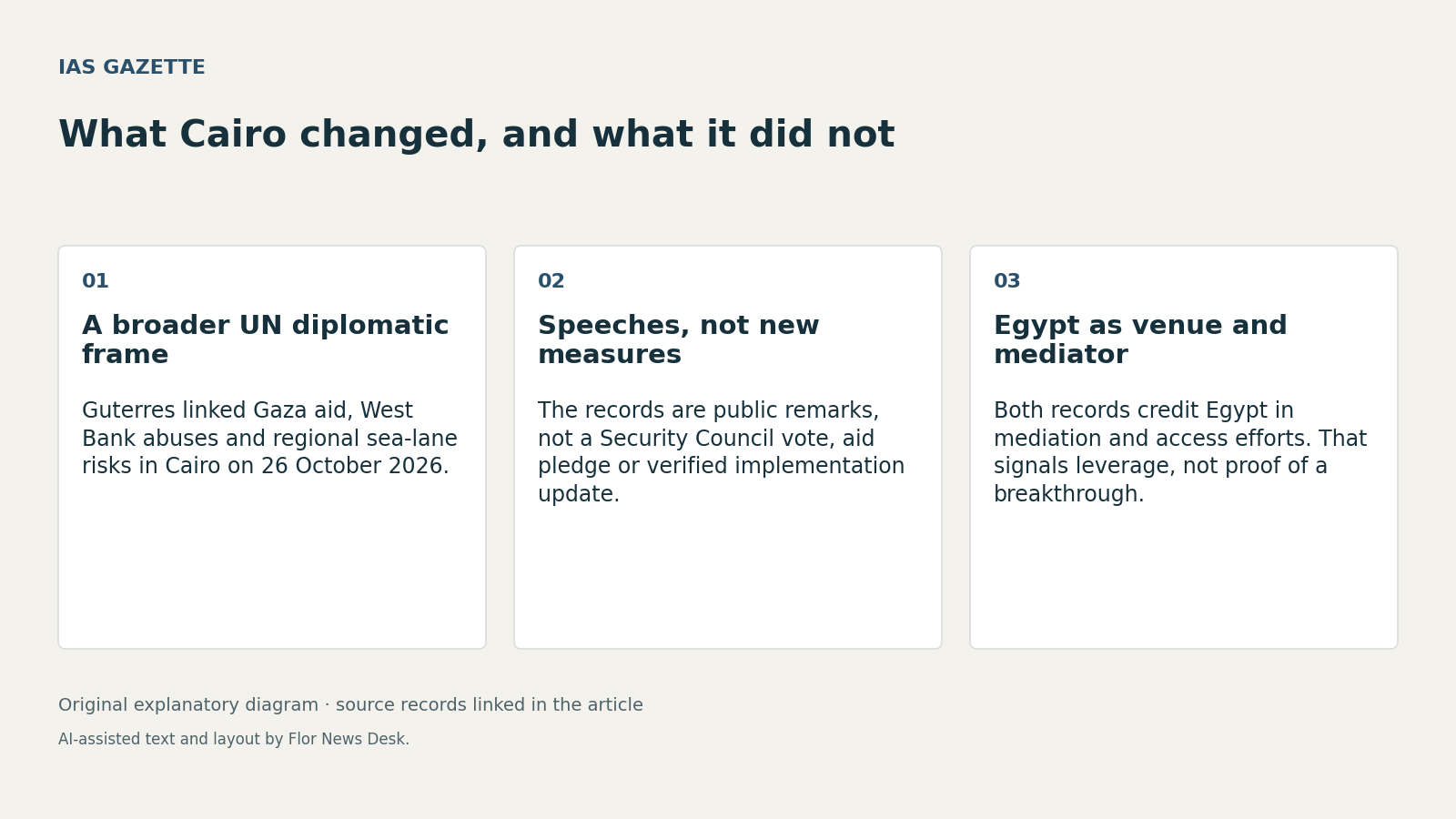
UN Secretary-General António Guterres used a 26 October 2026 visit to Cairo to do more than repeat calls for relief in Gaza. In press remarks and a Cairo University speech, he tied the war to three connected files: humanitarian access in Gaza, Israeli actions in the occupied West Bank, and the risk that regional tensions could widen into a United States-Iran confrontation and renewed disruption to major sea lanes. The available record matters because it shows a senior UN intervention from a key Arab mediator’s capital, but it remains a political intervention in speeches, not a new Security Council measure, funding commitment or verified operational change on the ground. UN press remarks Cairo University remarks
The Cairo setting was part of the message. In the press appearance, Guterres said Egypt had been central to Gaza mediation and humanitarian efforts, including aid flows, medical evacuations and the work of humanitarian partners such as the Egyptian Red Crescent. In the university speech, he again credited Egypt with an essential role in mediation, humanitarian access and efforts to stop the fighting. That does not prove a negotiating breakthrough. It does show the UN secretary-general choosing to reinforce an existing regional channel rather than unveil a separate diplomatic track. UN press remarks Cairo University remarks
The sharpest substantive point was that Guterres did not confine his intervention to Gaza. In Cairo, he said he was deeply alarmed by Israeli actions in the occupied West Bank, citing settlement expansion, evictions, rising settler violence and attacks on Palestinian families, journalists and diplomats. He also restated that a two-State solution remained the only viable path, with Gaza and the West Bank forming parts of a Palestinian state and Jerusalem the capital of both states. As analysis, combining those points suggests the UN is resisting an aid-only framing of the crisis: immediate relief is being argued alongside the longer political horizon. The speeches do not, however, establish any new negotiating format or recognition step. UN press remarks
Both Cairo records also referred to the Comprehensive Plan to End the Gaza Conflict, which Guterres said had been endorsed by the Security Council. In the press statement, he said Israeli restrictions on humanitarian assistance should be lifted and obstacles to implementing that plan should be removed. At Cairo University, he said the plan should be implemented in full. The source record does not describe the plan’s contents, current implementation status or outcomes. That limitation matters: mention of a plan is not evidence that parties have moved closer to carrying it out. UN press remarks Cairo University remarks
Guterres also used Cairo to widen the frame beyond Israel and Palestine. In the press remarks, he praised Egypt’s role in helping create conditions for dialogue between the United States and Iran, warned that a major escalation could spin out of control, and called for navigational rights and freedoms to be restored around the Strait of Hormuz and the Bab al-Mandab. In the university speech, he linked the Gaza war, Red Sea disruption and the Strait of Hormuz crisis to pressure on trade, energy costs, transport costs and inflation. The analytical significance is that the UN is addressing Gaza not only as a battlefield and humanitarian emergency, but as a trigger for shipping, energy and great-power risk. The speeches still provide no independent evidence about the condition of those routes or any agreed de-escalation channel. UN press remarks Cairo University remarks
The Cairo University speech placed that warning inside existing UN and international legal processes. Guterres said he had repeatedly condemned Hamas’s 7 October attacks, said nothing could justify what followed for Palestinians in Gaza, referred to findings by the Independent International Commission of Inquiry on the Occupied Palestinian Territory, including East Jerusalem, and Israel, and said parties must comply with the International Court of Justice’s provisional measures in the genocide case concerning Gaza. Institutionally, that is continuity rather than novelty: the secretary-general was anchoring his message in already existing UN and court frameworks, not announcing a new mechanism. Cairo University remarks
For diplomats and donors, the practical change from 26 October 2026 is therefore one of pressure and emphasis. Cairo became the venue for a renewed UN attempt to bind ceasefire diplomacy, West Bank realities and regional security into one argument. What follows should be judged by later decisions, readouts and measurable changes in access, violence or maritime passage. Those outcomes are not established by these two speech records alone. UN press remarks Cairo University remarks
Read our editorial standards or send a correction to the editorial desk.