
ASEAN economic ministers discussed both the existing goods agreement and preparations for its upgrade in Manila on September 19. Their agenda also included transit systems and arrangements for trusted traders. These initiatives can support the same shipment while addressing different problems at the border.
The ASEAN meeting account distinguishes implementation of the current ASEAN Trade in Goods Agreement from preparations for the amended agreement's entry into force. It does not announce that the upgrade became effective at that meeting. Readers should preserve that distinction when assessing claims about newly available trading conditions.
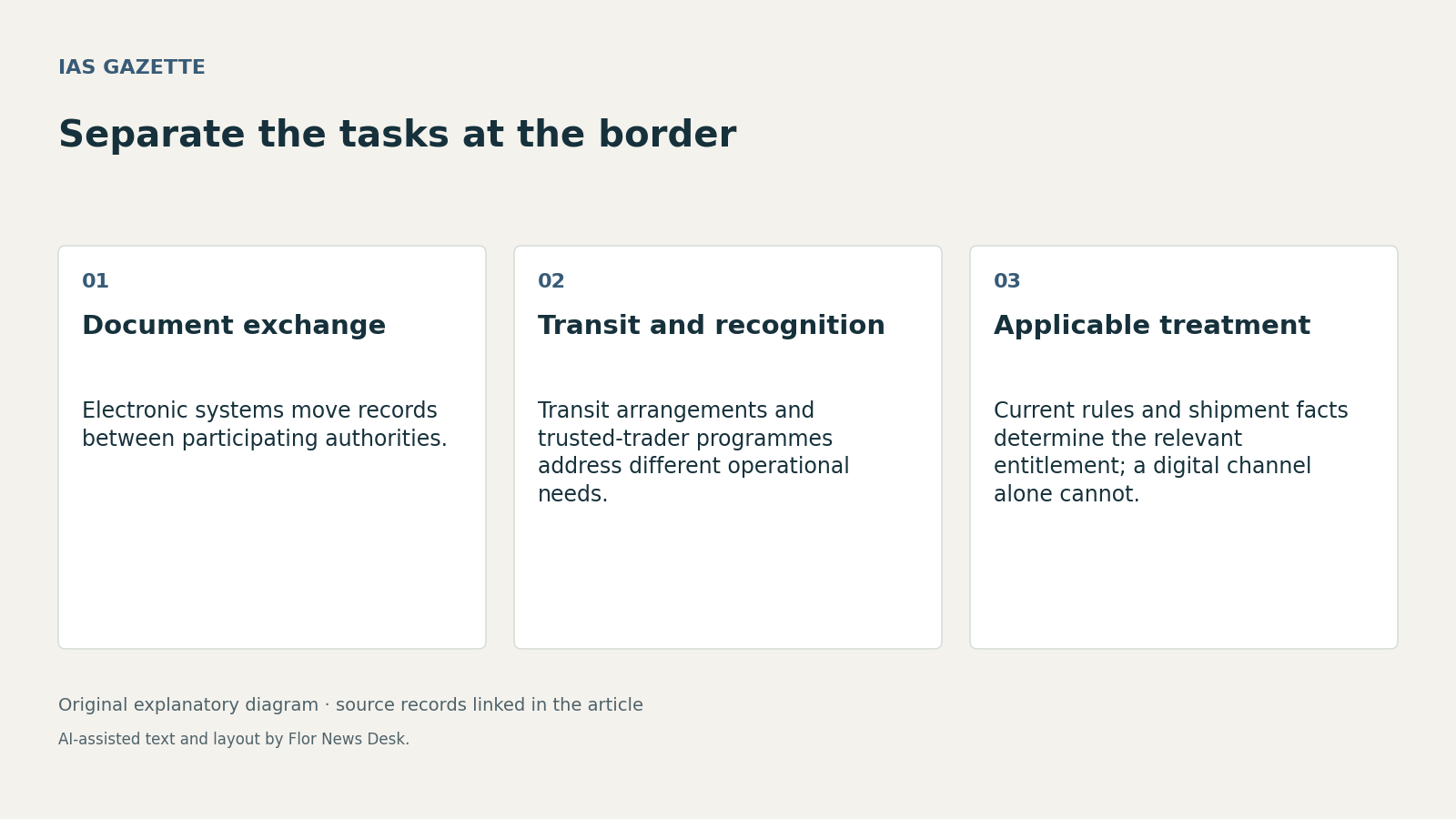
Documents, movement and recognition
The ASEAN Single Window portal explains that national systems exchange border-related documents electronically. It records the start of region-wide electronic certificates of origin among the then ten members in December 2019. Some other dates on the page describe earlier implementation plans, so they should not be carried forward as a current coverage list.
ASEAN's customs overview describes a separate transit system using a digital declaration and a guarantee across participating countries. It also describes mutual recognition of national authorized-economic-operator programmes and a shared system for classifying goods. Document exchange, transit management, trader recognition and product classification are distinct functions.
The analytical consequence is simple: a digital channel cannot answer every question about a shipment. The ability to transmit a document does not itself establish the truth of the information in it. A product code identifies a classification; by itself it does not prove where the product originated. A transit arrangement addresses movement through a route, while other records establish the treatment applicable at the destination.
Map the specific obstacle
Imagine a hypothetical exporter whose certificate arrives electronically but whose shipment still needs a factual query resolved. Faster transmission would be a real improvement. It would not settle that separate query or demonstrate that the entire clearance process had become instantaneous.
Conversely, a delay at one stage would not show that every regional system had failed. A useful account would identify the document, route, authority and step involved. That level of detail allows readers to distinguish a technical exchange problem from an incomplete record or an unresolved rule question.
This example is not a report of an actual delayed shipment or advice on obtaining a tariff preference. An individual shipment would require the relevant current rules and facts. It illustrates why reporting on trade facilitation should name the process being improved.
Measure completion as well as connectivity
A cross-border system can be assessed through several measures: participating routes, successfully exchanged records, requests needing correction and time to complete the relevant procedure. The denominator and period matter. Results for participating transactions do not automatically describe every shipment in the region.
The September meeting brings these operational questions into the same regional discussion as the goods-agreement upgrade. Following each initiative separately gives readers a better account of integration: which rule changed, which process works, and which practical step remains unresolved for the businesses using it.
Read our editorial standards or send a correction to the editorial desk.