
A UN Security Council resolution can pass without the affirmative vote of every permanent member. An abstention by one of those members can allow adoption if the proposal receives the necessary nine votes in favour. For readers following diplomacy, that creates a distinction between supporting a text and choosing not to prevent its adoption.
The Council’s official explanation of voting sets out the nine-vote requirement. It distinguishes procedural decisions from other matters and explains how a negative permanent-member vote can block a substantive proposal. An abstention is not counted as an affirmative vote, but the Council’s established practice allows adoption without all five permanent members voting yes.
This is a guide to interpreting the voting mechanism. It does not describe a particular recent vote or attribute motives to any government.
Count the affirmative votes first
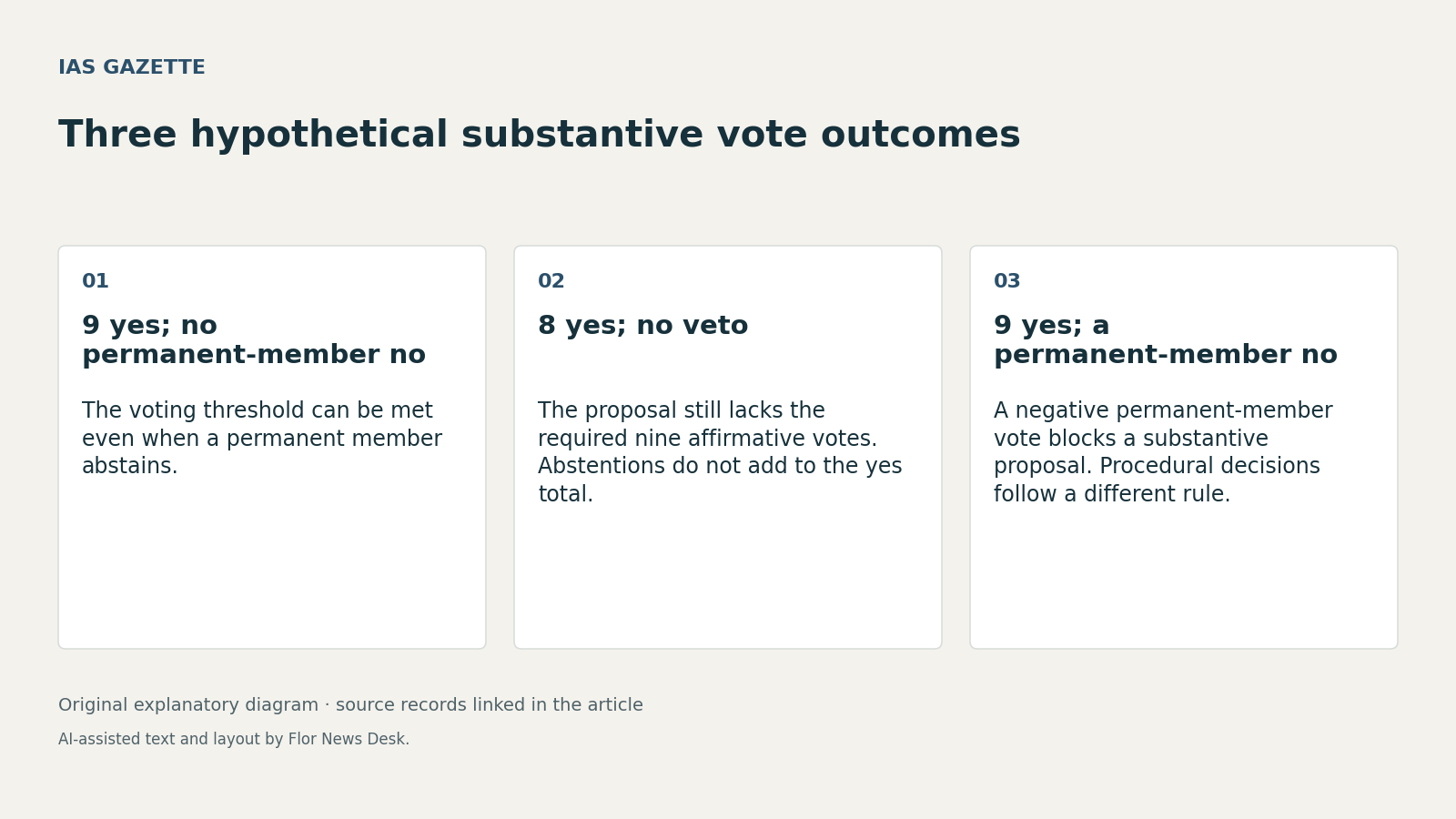
Consider a hypothetical substantive proposal receiving nine votes in favour, no votes against and six abstentions, including one by a permanent member. On the voting conditions described above, the abstentions do not prevent adoption.
Change the tally to eight votes in favour and seven abstentions. The absence of a veto would still leave the proposal short of the required affirmative votes. A headline explaining the failure solely through permanent-member positions would miss the role of the rest of the Council.
Now imagine nine affirmative votes with a permanent member voting against the substantive proposal. That is a different obstacle: the permanent member’s negative vote blocks adoption. Procedural matters follow a different rule, so the type of decision belongs in the explanation.
These examples are deliberately simplified. An actual report should use the recorded tally and identify the draft being voted on, rather than reconstructing a result from speeches or public expectations.
Read what the Council decided
The Council’s statement of its functions and powers describes a range of work, from investigating disputes and recommending approaches to applying sanctions and taking action to maintain international peace and security. Those activities have different consequences.
A vote count alone cannot tell a reader which of them a specific text undertakes. The operative provisions, named recipients, timetable and any implementation arrangements need to be read alongside the result. Describing every adopted text with the same shorthand would obscure what changed.
Nor does a large majority measure subsequent compliance. Adoption is an institutional decision at a particular moment. Evidence about implementation must come from later actions and reporting.
A diplomatic signal needs an attributed explanation
An abstaining government may explain its position in a statement before or after the vote. That statement can reveal objections, conditions or priorities in the government’s own account. The abstention by itself does not establish which of those reasons motivated it.
A useful report therefore keeps three records together: the proposal’s text, the formal voting result and the participating states’ explanations. If the text changes during negotiation, the final version is the relevant one for understanding the vote.
That approach makes room for diplomatic nuance without inventing it. A government can decline to endorse a proposal while allowing the Council to act, and an adopted resolution can still leave substantial disagreements unresolved.
Read our editorial standards or send a correction to the editorial desk.