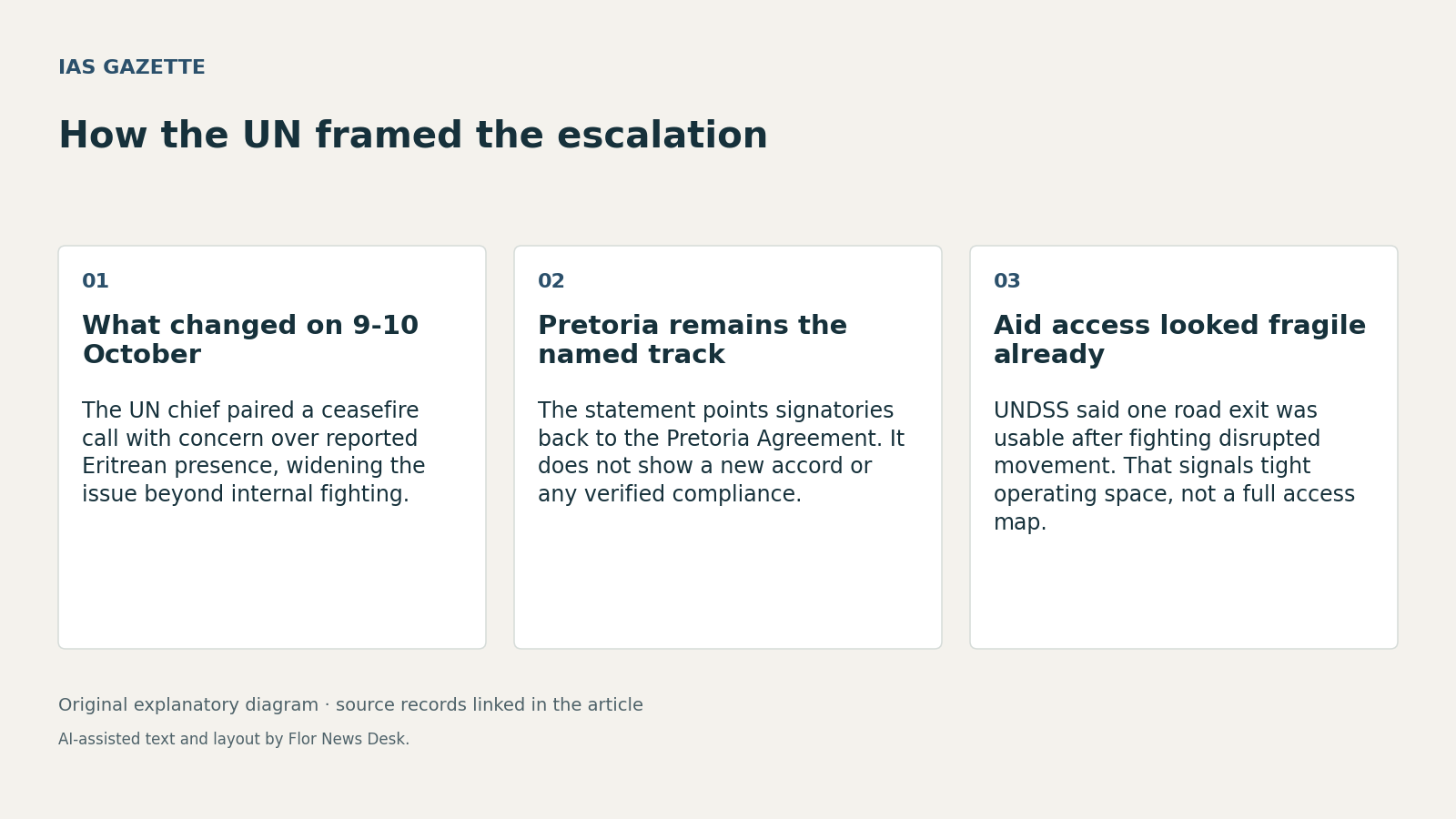
The immediate diplomatic change is not a new peace mechanism but the United Nations Secretary-General’s decision to publicly recast renewed fighting in northern Ethiopia as a regional risk. In a statement dated 9 October 2026 and published on 10 October, the Secretary-General said he was gravely concerned by renewed fighting in Tigray, Afar and Amhara, called for an immediate ceasefire, and expressed concern about reports of Eritrean forces being present in Ethiopia UN statement. That combination matters because it shifts the public message from a domestic relapse in violence to a conflict that could draw in state actors beyond Ethiopia’s internal belligerents.
The wording also shows what the UN is, and is not, doing at this stage. The same statement urged signatories to return to dialogue under the framework of the Pretoria Agreement, said the Secretary-General stood ready to offer his good offices, and reminded states in the region of their obligations under the UN Charter and the principle of non-interference UN statement. Read together, those elements amount to a diplomatic warning and a mediation offer, not evidence of a new negotiated text, a Security Council measure, or verified compliance by any party.
The reference to Eritrean forces is especially important because the cited UN record does not present it as an established finding. The statement says the Secretary-General is concerned by reports of Eritrean forces being present in Ethiopia, which is weaker than a documented UN verification UN statement. That distinction should shape how readers interpret the escalation. The institutional significance lies in the Secretary-General choosing to surface the allegation anyway, thereby signaling that even unverified cross-border involvement is serious enough to affect regional stability calculations.
A separate UN operational note helps explain why the Secretary-General’s intervention is not only about diplomacy. On 6 October 2026, the UN Department of Safety and Security said 19 humanitarian personnel who had been in Tigray reached Gondar by road on 30 September after fighting escalated on 23 September and disrupted movement and communications across Tigray and parts of Amhara UNDSS account. UNDSS said one overland route remained usable and that the movement required security clearances and agreement from authorities at several points UNDSS account. The analytical point is narrow but important: when access depends on a single route and multiple permissions, renewed fighting can rapidly become an operational constraint even before broader humanitarian data are available.
That operational fragility is reinforced, though not updated, by the same UNDSS note’s staffing figures. As of its 6 October publication, UNDSS said about 240 UN personnel and 1,700 personnel from international NGOs and implementing partners were operating in Tigray, while the department maintained twice-daily check-ins with UN personnel there UNDSS account. The article does not prove wider aid suspension or the current status of those staff on 13 October. It does show that the UN had enough personnel exposed to disrupted access for a public ceasefire appeal to carry a practical protection rationale alongside its political one.
What the cited record still cannot establish is as important as the warning itself. The UN materials summarized here provide no casualty or displacement figures, no documented responses from Ethiopia or Eritrea, and no evidence that fighting had eased or worsened after 10 October UN statement UNDSS account. As of 13 October 2026, the strongest supported conclusion is therefore limited: the UN has publicly raised the diplomatic stakes by tying a ceasefire demand, the Pretoria framework and reported Eritrean involvement into one message, while its own security reporting shows how little operational slack existed even before that warning.
Read our editorial standards or send a correction to the editorial desk.